
South Korean SMR-powered container ship design certified
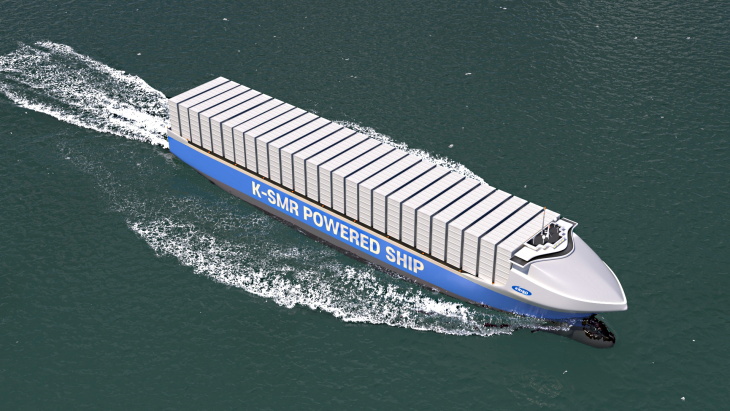
The Korea Research Institute of Ships & Ocean Engineering (KRISO) has received Approval in Principle (AiP) from the American Bureau of Shipping (ABS) for the conceptual design of a 15,000 TEU container ship powered by two small modular molten salt reactors (SMRs). The approval confirms that the design complies with the intent of applicable classification rules and industry standards at the conceptual stage. Developed in cooperation with Samsung Heavy Industries and the Korea Atomic Energy Research Institute (KAERI), the vessel features a redundant two-reactor configuration, an integrated energy storage system, and a hull optimised for safety, efficiency, and cargo capacity. The reactors are positioned centrally to minimise collision risks and wave impacts, while the removal of conventional fuel tanks and funnels increases loading efficiency. KRISO also carried out model tests in a deep-sea engineering tank to assess ship motion and reactor integration under various marine conditions. The institute plans to continue with basic and detailed design activities to support the future demonstration and commercial deployment of nuclear-powered vessels, contributing to maritime decarbonisation objectives.
Mochovce 4 preparing for physical start-up tests
Slovenské elektrárne has announced the completion of reactor assembly and hermetic sealing at Slovakia’s Mochovce Unit 4, marking the end of a key phase in the plant’s commissioning. Following the loading of all 349 fuel assemblies, the unit has successfully undergone a series of inspections and tests confirming the readiness of the primary circuit for physical start-up. The next steps include strength and leak tests, pre-critical tests, and the first controlled nuclear fission chain reaction. The operator expects the 471 MWe VVER-440 unit to supply its first electricity to the national grid after synchronisation of the turbine generator in late summer 2026. Power output will then be increased gradually through a comprehensive testing programme, culminating in a 144-hour full-power trial. Once Unit 4 enters commercial operation, nuclear energy is expected to provide approximately 77.5% of Slovakia’s electricity consumption, representing the highest share of nuclear-generated electricity in the world.
Rolls-Royce SMR Signs Agreement For Work At Two Additional Reactor Sites In Czech Republic
Rolls-Royce SMR, Czech utility ČEZ and the Czech Ministry of Industry and Trade have signed a memorandum of understanding (MoU) to begin site preparation activities for two additional small modular reactor (SMR) locations in the Czech Republic. The agreement expands the existing cooperation, which already includes plans to construct the country’s first SMR at the Temelín nuclear power plant. The additional sites are Tušimice in the Ústí nad Labem region and Dětmarovice in the Moravian-Silesian region. The MoU supports the Czech government’s strategy to deploy up to 3 GW of SMR generating capacity, equivalent to at least six Rolls-Royce SMR units. Czech officials highlighted the role of nuclear energy in strengthening long-term energy security, supporting economic stability and creating opportunities for domestic industry. Rolls-Royce SMR described the agreement as another milestone towards fleet deployment, building on its planned projects in the United Kingdom, Sweden and the Czech Republic as part of its broader international expansion strategy.
Researchers Achieve Remote, Autonomous Power Control Of Research Reactor In Real Time
Researchers from Idaho National Laboratory (INL), the University of Illinois Urbana-Champaign and Purdue University have successfully demonstrated remote, autonomous real-time power control of the PUR1 research reactor in the United States. The project combined high-performance computing, cloud-based technologies and artificial intelligence to automatically regulate reactor power while ensuring that the reactor’s built-in safety systems retained full authority over all operations. The demonstration connected computing resources in Idaho, the PUR1 reactor in Indiana and a Microsoft Azure cloud environment in Virginia. A digital control loop was first used for remote power adjustments before being enhanced with a reinforcement learning model capable of autonomously optimising reactor operation. The system calculated control instructions for an auxiliary control rod to minimise power fluctuations without requiring manual control-rod manipulation on site. Researchers said the achievement represents an important step towards future autonomous nuclear power plant operation, supporting improved safety, operational efficiency and reliability while providing new opportunities for reactor control research and the education of future nuclear engineers.
Advanced Nuclear Company Unveils Generation IV Reactor Project For Southern France
French advanced nuclear technology developer Stellaria has announced a new Generation IV reactor project for the Fos-sur-Mer industrial area in southern France through a memorandum of understanding signed with Unitel Group and Energie Hub. The agreement aims to establish an integrated low-carbon energy hub featuring the phased deployment of several Stellarium molten salt reactor units. The reactors are intended to provide electricity, industrial heat, grid flexibility and energy support services for local industry while contributing to France’s long-term energy sovereignty. The project also includes the development of an artificial intelligence-based digital energy management platform to optimise electricity generation and consumption, manage energy storage and forecast industrial demand. The partners will cooperate on project financing, governance and future operation. The announcement follows earlier agreements with the French Alternative Energies and Atomic Energy Commission (CEA) to prepare testing infrastructure for the Alvin prototype reactor, with critical experiments planned for 2030 as Stellaria advances the commercial development of its Generation IV technology.
EDF extends life of UK’s Heysham 1 and Hartlepool
EDF has announced a two-year extension of operations for the Heysham 1 and Hartlepool advanced gas-cooled reactor (AGR) nuclear power stations, which are now scheduled to continue generating electricity until March 2030. The decision follows a comprehensive technical and commercial assessment covering reactor condition, boiler and graphite core integrity, supply chain resilience and workforce planning. According to EDF, the extension could add approximately 28 TWh of low-carbon electricity to the UK grid, sufficient to supply around 8.4 million homes, while supporting more than 1,000 jobs across the two sites. The company said the additional generation will strengthen energy security, reduce reliance on imported natural gas and help maintain grid stability as renewable energy capacity expands. EDF noted that continued operation of the two stations could preserve around 12% of the UK’s nuclear generation in 2028. The company will continue reviewing the remaining operating lives of its AGR fleet to determine whether further lifetime extensions remain technically safe and commercially viable.
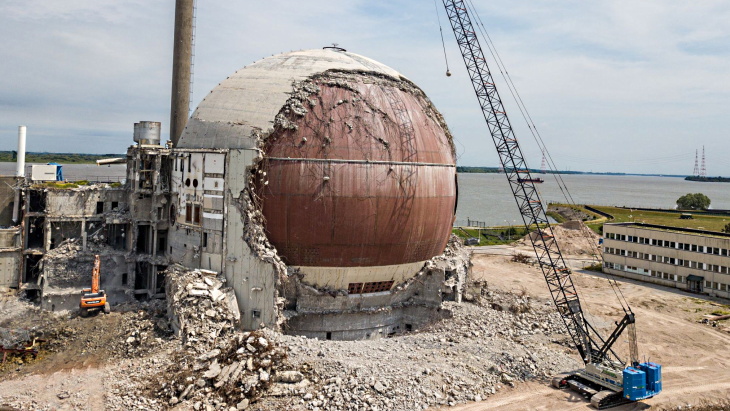
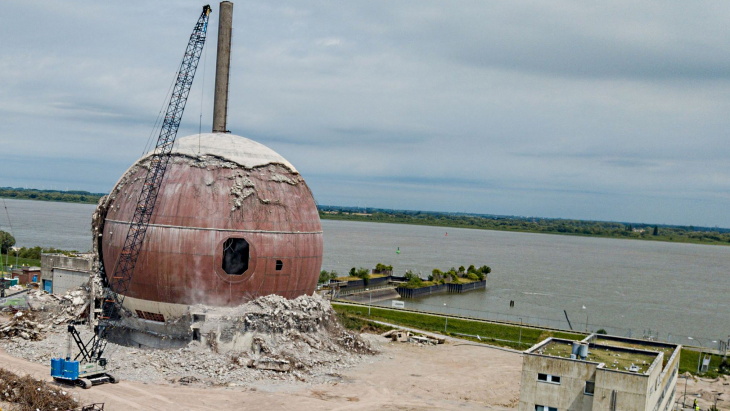
In pictures: Demolition of Stade reactor building progresses
Demolition of the reactor building at the decommissioned Stade nuclear power plant in Lower Saxony, Germany, is progressing according to schedule and is expected to be completed by the end of 2026. The work, which began at the end of March, represents the second phase of the plant’s conventional dismantling programme and the start of the project’s final technical stage. After extensive hazardous material removal and site preparation, demolition crews used heavy equipment, including a four-tonne wrecking ball, hydraulic shears and a cable excavator, to dismantle the reinforced concrete reactor structure and adjacent buildings. Stade, a 640 MWe pressurised water reactor commissioned in 1972, was the first German nuclear power plant to enter decommissioning following the country’s 2003 nuclear phase-out policy. Conventional demolition of non-nuclear structures began in 2023 after earlier dismantling activities inside the plant. The site is expected to be released from nuclear regulatory control in 2027, making Stade the first commercially operated pressurised water reactor in Germany to be completely dismantled.