

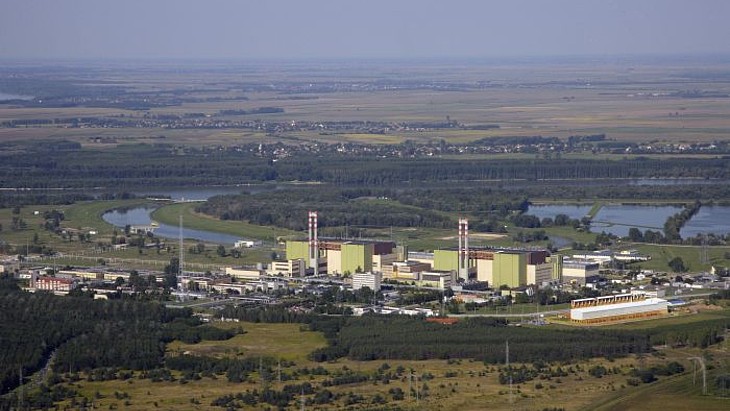
Danube’s record low leads to Hungary, Romania nuclear shutdowns
Record-low water levels in the River Danube are disrupting nuclear power generation in Hungary and Romania amid severe drought and a wider European heatwave. Hungary’s MVM said all four reactors at the Paks nuclear power plant may need to shut down within 24–72 hours as falling river levels threaten the operation of cooling-water intake pumps. The company stressed that there is no nuclear safety issue and that sufficient cooling can be maintained after shutdown. In Romania, Cernavoda Unit 1 has already been taken offline as a preventive measure, while Unit 2 remains operational but could also be shut down if conditions deteriorate. The extreme conditions are affecting nuclear facilities elsewhere in Europe. France’s EDF has temporarily shut down several reactors and reduced output at others to comply with environmental limits on cooling-water discharges, while Switzerland’s Beznau plant has also faced restrictions. Operators are implementing measures to maintain nuclear safety and adapt facilities to increasingly challenging hydrological conditions.
Germany Announces National Hubs In Bid For Europe’s First Fusion Reactor In 2040s
Germany has announced plans to establish three national nuclear fusion hubs as part of its strategy to host Europe’s first commercial fusion power plant in the 2040s. The government plans to provide an initial €125 million in funding, supporting research and development in laser and magnetic fusion, fuel cycles and advanced materials. The hubs will be centred at the former Biblis nuclear power plant, Karlsruhe and Garching near Munich, with additional research facilities participating across northern Germany. They are intended to bring together industry, research institutions and technology companies to accelerate the development of commercially viable fusion energy. Germany has shut down all its nuclear power plants but continues to invest in advanced nuclear technologies, with the government aiming to become the first country to connect a fusion reactor to the grid. Several projects are already under development, including Proxima Fusion’s Alpha test reactor and planned Stellaris commercial-scale facility, as well as a laser fusion project led by Focused Energy at the former Biblis site.
Progress reported on Shirondukuyskoye deposit works
Rosatom’s mining division, Rosatom Nedra, has reported progress in the development of the Shirondukuyskoye molybdenum-uranium deposit in Russia’s Zabaykalsky Krai. Underground crews from the Priargunsky Industrial Mining and Chemical Union (PIMCU) completed three kilometres of underground mine workings ahead of the scheduled 10 August deadline. The new underground link is expected to improve ventilation, rock transport logistics and operational safety at the mine’s fourth level, supporting further development of the deposit. Located about eight kilometres from Krasnokamensk, Shirondukuyskoye forms part of the Streltsovsky uranium ore district. Rosatom obtained the development licence in February 2025, and the deposit contains an estimated 8,000 tonnes of uranium reserves in Russia’s C1/C2 categories, as well as molybdenum resources. Rosatom Nedra considers the project important for expanding Russia’s uranium resource base and supporting long-term mining activity in Krasnokamensk. Most major capital mining work is scheduled for completion in 2026, with uranium production of around 400 tonnes annually expected to begin in 2028.
Superyacht Industry ‘Needs To Begin Transition To Nuclear Now’
The superyacht industry should begin preparing for the potential introduction of nuclear propulsion despite significant technical, regulatory and societal challenges, experts said at the Monaco Energy Boat Challenge 2026. Engel-Jan de Boer of Lloyd’s Register said advances in maritime nuclear technologies and growing pressure to decarbonise shipping are moving nuclear-powered yachts beyond purely theoretical discussion. Potential advantages include virtually unlimited range, reduced dependence on conventional refuelling infrastructure, lower operational emissions and greater onboard energy availability. However, nuclear propulsion would require solutions for safety, regulation, crew training, port access, insurance, radioactive waste management and public acceptance. Classification societies are expected to play an important role in developing appropriate safety and risk-assessment frameworks. Interest in the concept is already emerging, with Espen Oeino International previously presenting a 120-metre nuclear-electric superyacht design. The broader debate reflects increasing interest in nuclear propulsion for maritime transport as the sector seeks alternatives to fossil fuels and works towards net-zero greenhouse gas emissions by around 2050.
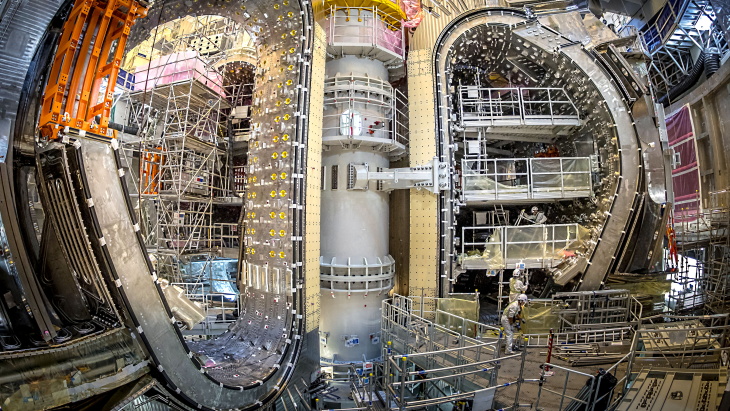
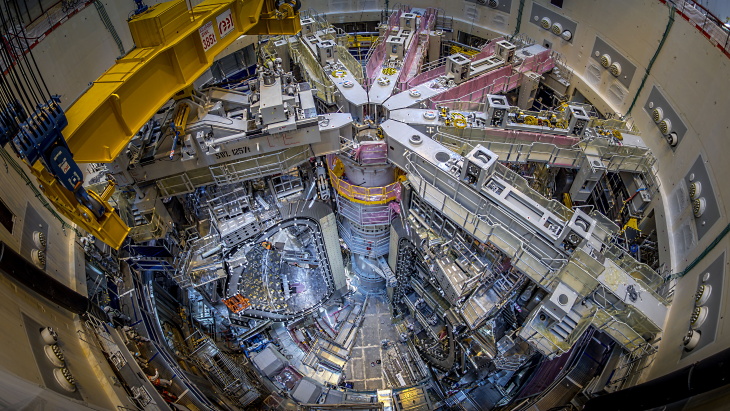
In pictures: ITER tokamak core assembly progressing
Assembly of the ITER fusion device has reached another milestone with the installation of the sixth of nine tokamak sector modules, almost six months ahead of schedule. The 1,100-tonne module was transferred from the Assembly Hall and lowered into the tokamak pit during a 30-hour operation involving more than 100 people. Six modules now form two-thirds of the torus-shaped core, with a seventh expected to be installed by the end of 2026 and the final module targeted for mid-2027. Each module comprises a vacuum vessel sector, two toroidal field coils, thermal shields and auxiliary components. Once all nine sectors are installed, they will be joined to complete ITER’s vacuum vessel, which will ultimately weigh about 8,500 tonnes with its internal components. ITER officials attribute the accelerated progress to experience gained from previous assembly operations. The international project aims to demonstrate the scientific and technological feasibility of large-scale fusion energy, with deuterium-deuterium fusion operations currently planned for 2035.
Core catcher installed at Leningrad’s eighth unit
A 157-tonne core catcher has been installed at Leningrad II-4, the eighth unit of Russia’s Leningrad nuclear power plant, marking a major milestone in construction of the VVER-1200 reactor. The steel component, also known as a melt trap, is a passive safety system designed to contain molten core material in the event of a severe accident and prevent radioactive substances from escaping the reactor containment. Installation took eight hours and was completed almost three months ahead of schedule, according to Rosatom. The milestone enables preparations to begin for installation of the reactor vessel, scheduled for 2029. Construction is also progressing on the double containment structure, internal floors and various process and safety systems. Leningrad II-4 is being built alongside Unit 7 to replace the plant’s remaining RBMK-1000 reactors as they are retired. The Leningrad plant currently supplies more than half of the electricity consumed in St Petersburg and the surrounding Leningrad region.