
First criticality for Mochovce 4
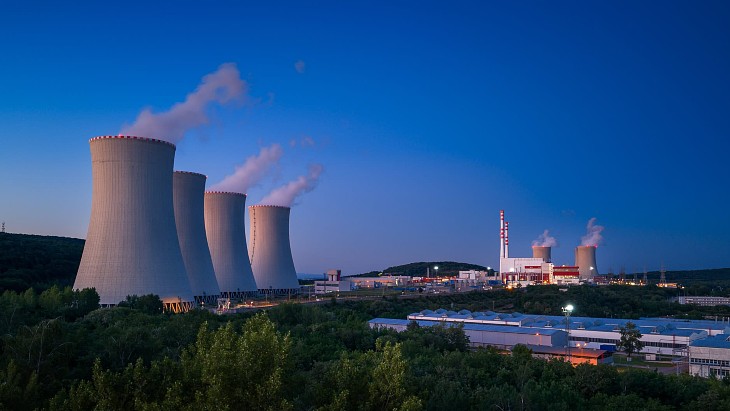
Slovakia’s Mochovce 4 nuclear power unit has achieved first criticality and minimum controlled power, marking a major milestone in its commissioning. Operator Slovenské elektrárne said the VVER-440 reactor reached criticality at 22:10 on 6 August, followed by minimum controlled power 21 minutes later. The achievement confirms that the reactor can sustain a controlled, self-supporting nuclear fission chain reaction and is ready to proceed to further commissioning tests. A series of tests will now be conducted at progressively higher power levels to verify the performance and safety of the plant’s systems. The commissioning programme will culminate in a 144-hour demonstration run at full power. Mochovce 4 has a generating capacity of 471 MW and, once operational, is expected to supply about 13% of Slovakia’s electricity needs. Together with the country’s other nuclear units, it will raise nuclear generation to the equivalent of approximately 77.5% of national electricity consumption, one of the highest shares worldwide.
US, EU bodies report on nuclear fuel market situation
Canada remained the largest source of uranium supplied to nuclear utilities in both the United States and European Union in 2025, closely followed by Kazakhstan, according to reports from the US Energy Information Administration and Euratom Supply Agency. US reactor operators purchased 46.9 million pounds U3O8 equivalent, 16% less than in 2024, with Canada accounting for 32% of deliveries, Kazakhstan 28% and Australia 15%. Domestic US uranium represented only 7%. In the EU, Canada and Kazakhstan also dominated supplies, while Russian-origin uranium still accounted for nearly 16% of deliveries. As the EU imports all of its fresh uranium requirements, the Euratom Supply Agency highlighted diversification and reducing dependence on Russia as key priorities for supply security. Progress was reported in diversifying fuel supplies for Russian-designed VVER reactors: by the end of 2025, all EU operators of VVER units had secured alternative fuel supply contracts with non-Russian suppliers, supporting the bloc’s broader strategy to phase out Russian energy imports.
Three Units Taken Offline At France’s Gravelines After Jellyfish Clog Pumps
Three reactors at France’s six-unit Gravelines nuclear power station were taken offline on 10 August after a swarm of jellyfish clogged pumps used to supply cooling water. Operator EDF also reduced output at a fourth reactor by half, leaving only one unit operating at full capacity, while a sixth was already offline for scheduled maintenance. EDF said the incident had no impact on nuclear safety, personnel or the environment. Gravelines, located near Dunkirk in northern France, is the largest commercial nuclear power station in Western Europe, comprising six reactors with a net capacity of 910 MW each. The disruption comes amid a challenging year for French nuclear generation, with several reactors previously curtailed or shut down because of heatwaves and drought. France recorded a 15.6% nuclear generation shortfall on 9 August compared with expected output. Gravelines has experienced similar problems before, with jellyfish clogging its seawater pumping stations and temporarily disrupting operations in 2025.
Romanian plant taken offline as Hungary moves to keep Paks operating
Romania has shut down both units of the Cernavoda nuclear power plant as record-low Danube water levels caused by severe drought continue to affect nuclear generation in the region. Unit 1 was taken offline on 28 July, while Unit 2 entered a controlled shutdown on 13 August after river levels fell below the threshold required for normal operation. Earlier emergency measures, including dredging, removing riverbed obstructions and sinking rock-filled barges, temporarily raised water levels but proved insufficient. Romanian authorities said nuclear safety remains unaffected and the national electricity system can compensate for the lost generation. In neighbouring Hungary, three of the four reactors at Paks have also been shut down, while Unit 2 has returned to full power following a temporary rise in Danube levels. The Hungarian government is implementing measures to secure cooling-water supplies, including construction of a riverbed sill and preparations to sink two barges if necessary, aiming to prevent a complete shutdown of Paks.
US poll finds support for deep geologic disposal
A nationwide US survey has found broad public support for developing a permanent solution for high-level radioactive waste, with 81% of respondents considering it a national priority. The YouGov poll, commissioned by nuclear waste technology company Deep Isolation, surveyed 1,000 adults on nuclear energy and radioactive waste management. Only 28% supported storing used nuclear fuel at reactor sites for many decades. After receiving information about geological disposal technologies, 65% supported deep borehole disposal, which involves placing waste in corrosion-resistant canisters in narrow holes drilled deep into stable rock formations. Although the technology has been studied internationally since the 1950s, it has not yet been implemented. The survey also highlighted continuing public concerns over safety, transport and long-term stewardship, while indicating strong trust in scientific and engineering expertise. The findings come as the United States considers long-term waste management options, with approximately 95,000 tonnes of used nuclear fuel currently stored at operating or former nuclear power plant sites.