

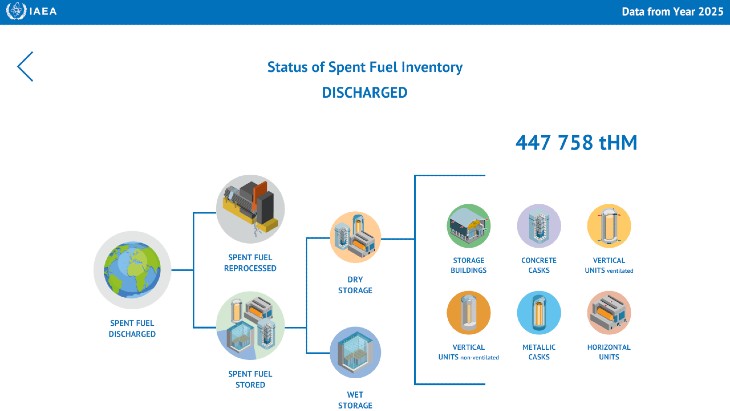
The International Atomic Energy Agency (IAEA) has launched its first interactive global mapping tool showing the amount and location of used nuclear fuel produced by nuclear power plants. According to the latest Global Spent Nuclear Fuel Inventory, around 448,000 tonnes of heavy metal have been generated worldwide. Approximately 75% remains in storage, while about 25%—roughly 126,000 tonnes—has been reprocessed for potential reuse in new nuclear fuel, reducing both radioactive waste and the need for natural uranium. Of the stored fuel, 41% is kept in wet storage, mainly in cooling pools, and 31% in dry storage systems such as casks and specialized buildings. The data, collected through the 2025 reporting cycle under the Joint Convention on the Safety of Spent Fuel Management, is supplemented by publicly available information. The IAEA says the new interactive tool will support technical analysis, improve transparency, and facilitate informed discussions on long-term spent nuclear fuel management.
Rosatom is planning to build a new high-capacity nuclear fuel reprocessing plant as part of Russia’s strategy to establish a closed nuclear fuel cycle. Feasibility studies and site selection are currently underway, with a final investment decision expected by the end of 2026. The facility will initially be designed to process 400 tonnes of used nuclear fuel per year, with a modular layout allowing future capacity expansion. Rosatom aims to reach full capacity within a decade, making it the largest spent fuel reprocessing plant in Russia and capable of handling fuel from both thermal and fast reactors. According to the company, the project will support the reuse of valuable nuclear materials, reduce radioactive waste, and strengthen Russia’s position in the global nuclear market. The plant will also build on technologies developed through the BREST-OD-300 fast reactor project, which is intended to demonstrate an integrated closed fuel cycle using recycled uranium-plutonium fuel.
Italy’s state-owned radioactive waste management company, Sogin, has begun re-encapsulating 64 spent nuclear fuel elements from the former Elk River experimental reactor in Minnesota, USA. The fuel has been stored for decades at the Itrec nuclear research and reprocessing facility in southern Italy and represents the only foreign spent nuclear fuel remaining in the country. Because of its unique uranium-thorium composition, the fuel is being transferred into dry storage containers before eventual disposal at Italy’s planned national radioactive waste repository. The operation involves placing each fuel element into new containers that will be loaded into two specially designed storage casks already located at the site. The project is an important milestone in the decommissioning of the Itrec facility and is expected to be completed by mid-2027. The Elk River fuel was originally shipped to Italy between 1968 and 1970 as part of an international research programme investigating the thorium-uranium nuclear fuel cycle.
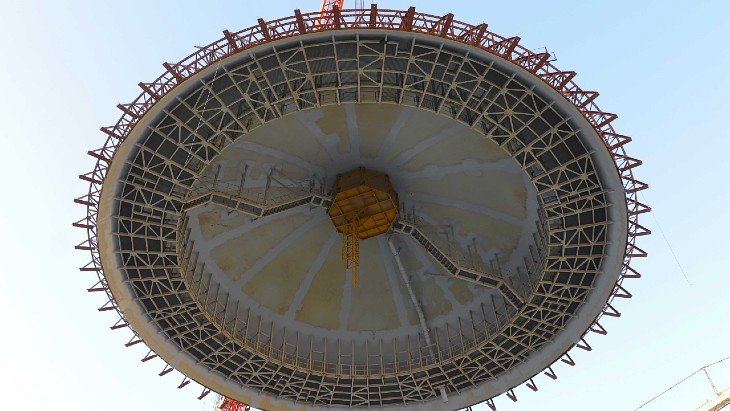
The inner containment dome has been successfully installed at Unit 2 of Turkey’s Akkuyu Nuclear Power Plant, marking a major milestone in the construction of the country’s first nuclear power station. The seven-hour lifting operation was carried out using a heavy-duty crawler crane and involved more than 40 specialists. The steel dome, consisting of 15 prefabricated sections, was assembled over four months before being lifted into position. According to Akkuyu Nuclear JSC, the installation is one of the most technically demanding stages of reactor construction and required months of planning and preparation. The next phase includes welding the dome to the containment structure and continuing reinforcement and concreting works. Rosatom is constructing four VVER-1200 reactors at the site under the build-own-operate (BOO) model. Unit 1 is expected to begin supplying electricity in 2026, while the completed 4,800 MWe plant is projected to generate around 10% of Turkey’s electricity demand.
France’s state-owned utility EDF has temporarily shut down two additional nuclear reactors as an exceptional heatwave raises river temperatures across the country. The affected reactors are located at the Nogent nuclear power plant on the Seine River and the Bugey nuclear power plant on the Rhône River. The precautionary shutdowns follow the earlier closure of a reactor at the Golfech plant and are intended to ensure compliance with environmental regulations that limit the temperature of cooling water discharged into nearby rivers. These rules are designed to protect aquatic ecosystems from excessive thermal impacts. EDF has also warned that additional reactors may need to reduce power output or temporarily shut down if temperatures continue to rise. According to Reuters, the reduced generation amounted to about 4.1 GWe, representing roughly 7% of France’s electricity demand at midday on 25 June. The measures highlight the increasing operational challenges that extreme weather poses for nuclear power plants.
India has inaugurated what it describes as the world’s first nuclear-powered hydrogen production facility, located at the Indira Gandhi Centre for Atomic Research in Tamil Nadu. The demonstration plant uses process heat from the 40 MWt Fast Breeder Test Reactor (FBTR) to produce hydrogen through the copper-chlorine thermochemical cycle, a technology developed by scientists at the Bhabha Atomic Research Centre. According to India’s Department of Atomic Energy, the project is designed to demonstrate the feasibility of producing hydrogen using nuclear energy and to support future large-scale, carbon-free hydrogen production. The copper-chlorine process is considered one of the most promising hydrogen production technologies because it operates at relatively low temperatures while achieving high thermodynamic efficiency. By replacing fossil fuels with nuclear process heat, the technology can significantly reduce greenhouse gas emissions. The project represents an important step in integrating advanced nuclear reactors with clean hydrogen production to support the global energy transition.