
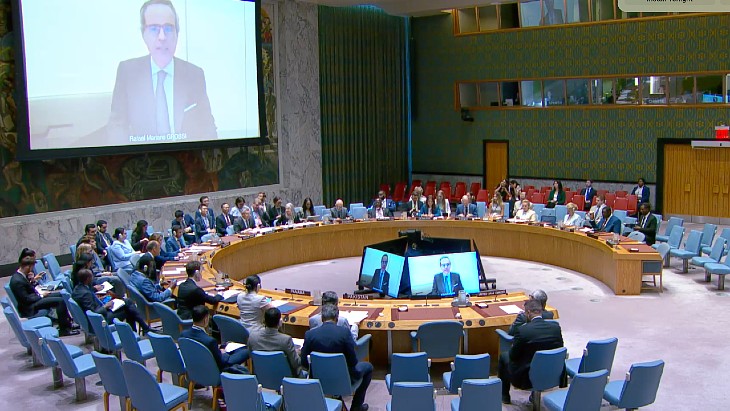
Rafael Grossi warned the United Nations Security Council that attacks on nuclear power plants could have catastrophic consequences after a recent drone strike near the Barakah Nuclear Power Plant in the UAE. Although the attack caused only a fire in an external electrical generator and radiation levels remained normal, Grossi stressed that a direct hit on an operating reactor or its power supply systems could trigger core melting and a major radioactive release. He explained that such an event could require mass evacuations, sheltering measures, iodine distribution, and food restrictions across large regions. The IAEA is monitoring the situation closely and remains prepared to provide emergency assistance and technical expertise. Grossi reiterated that attacks on civilian nuclear facilities violate international humanitarian law and called for maximum military restraint and diplomatic solutions to prevent escalation and protect nuclear safety worldwide.
Public support for nuclear energy in the Czech Republic has reached a record 85%, according to a survey conducted by Ipsos in cooperation with ČEZ Group. The results show that energy security and concerns over dependence on imported electricity are the main reasons behind strong support for nuclear power. Nearly all respondents considered national energy self-sufficiency important, while many associated electricity imports with higher prices and unstable supply. The survey also found growing support for combining nuclear and renewable energy sources, with almost three-quarters backing a mixed energy strategy. Around 60% of respondents believe nuclear power should provide the largest share of the country’s future electricity generation. Support is increasing even in industrial and former coal-mining regions. The Czech Republic currently operates six nuclear reactors and is preparing to build new South Korean-designed reactors at the Dukovany Nuclear Power Plant, with possible future expansion at Temelín Nuclear Power Plant.
Germany has joined the European Important Project of Common European Interest (IPCEI) focused on nuclear fusion and plans to invest about EUR 2.4 billion in the technology. The government described fusion as a strategic priority and part of its broader High-Tech Agenda, which also includes artificial intelligence, quantum technologies, biotechnology, and climate-neutral energy solutions. Research minister Dorothee Bär said Germany aims to host the world’s first fusion power plant, while economy minister Katherina Reiche stressed that fusion is no longer a distant concept but an urgent industrial and strategic task. The initiative seeks to connect research institutions, startups, and industry in order to accelerate commercial deployment. Germany is targeting the connection of a fusion reactor to the electricity grid by 2040. The renewed focus on nuclear technologies comes after growing criticism of Germany’s 2023 nuclear phaseout, which political leaders including Chancellor Friedrich Merz and Reiche have recently described as a costly strategic mistake for the country’s economy and energy security.
Serbia has received what President Aleksandar Vučić described as an “incredible proposal” from China for the possible construction of the country’s first nuclear power plant. Following meetings with Chinese premier Li Qiang and President Xi Jinping during an official visit to China, Vučić highlighted favourable financing conditions, pricing, and construction timelines offered by Beijing. Serbia is currently evaluating nuclear energy as part of its long-term strategy to strengthen energy security and reduce carbon emissions. A preliminary technical study prepared by France’s EDF outlines a roadmap that could lead to the commissioning of Serbia’s first nuclear power plant around 2040, with technology selection and construction contracting potentially beginning by 2032. Serbia lifted its long-standing moratorium on nuclear power development in 2024 and has since signed cooperation agreements with several international partners. Officials stress that any future nuclear programme will require extensive expert analysis, regulatory preparation, workforce development, and broad public and political consensus before implementation can begin.
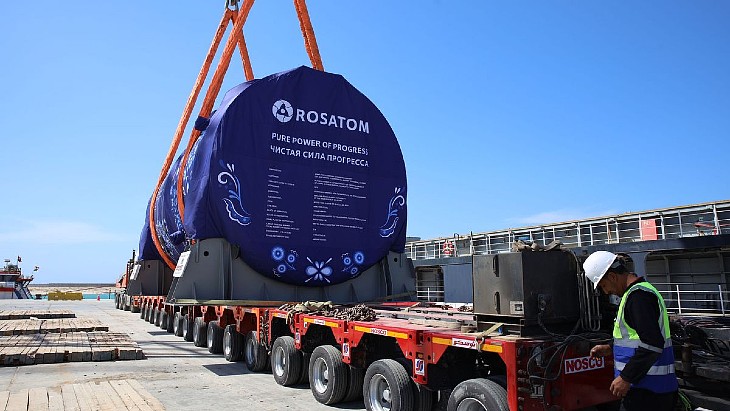
Russia’s state nuclear corporation Rosatom has completed what it described as the largest single shipment of nuclear equipment ever delivered for one nuclear power plant project. The cargo, weighing about 2,000 tonnes, was transported from the Atomash plant in Volgodonsk to Egypt’s El Dabaa nuclear power plant. It included a 330-tonne reactor pressure vessel for Unit 2, four steam generators, and a pressuriser for Unit 1. The equipment was shipped aboard the Alexander Udalov, a vessel designed for both river and maritime transport, enabling direct delivery to the specially constructed port at the El Dabaa construction site. Egypt’s energy minister Mahmoud Esmat said the project remains on schedule and is central to the country’s long-term energy strategy. El Dabaa will become Egypt’s first nuclear power plant and Africa’s first new nuclear facility since South Africa’s Koeberg plant. The four-unit project is being built by Rosatom, with the first two units expected to begin commercial operation before 2030.