

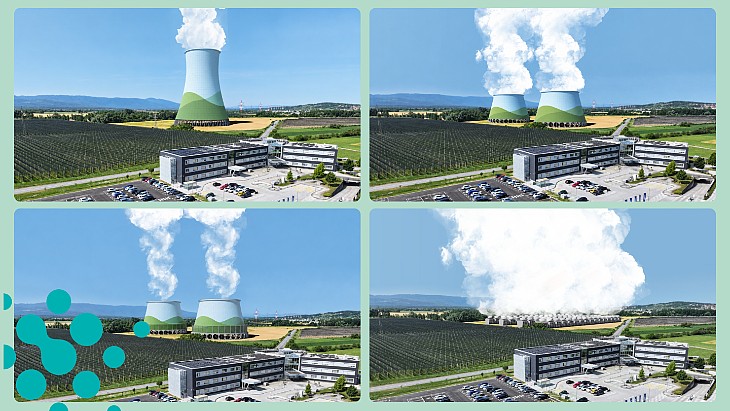
Natural draft cooling tower is preferred JEK2 option
A feasibility study for Slovenia’s proposed JEK2 nuclear power plant has identified a natural draft cooling tower as the preferred option. The study, carried out by engineering company John Cockerill Hamon, assessed four technologies. The proposed natural draft tower would be approximately 193–198 metres high, with its final height depending on the reactor technology selected.
The natural draft design was preferred because of its reliable operation, very low electricity consumption and lower maintenance requirements, as it does not require fans to provide airflow. A combined natural and mechanical draft system was identified as an alternative, requiring two towers approximately 75–80 metres high but involving higher operating costs. Climate-change impacts were included in the assessment, while the final choice remains subject to further technical and spatial planning procedures.
A preliminary transport study examined eight routes for transporting large components to Krško. The preferred option is a 274-kilometre road route from Koper via Ljubljana and Celje, requiring modifications at 112 locations. The final transport study could be completed by the end of 2028.
JEK2’s Final Investment Decision is planned for 2028 or 2029, with construction currently envisaged from 2033 and commercial operation in 2041.
EDF Planning To Build 10 Nuward SMRs In Europe By 2035, Says Executive
France’s EDF plans to build 10 Nuward small modular reactors (SMRs) in the European Union by 2035, according to senior vice-president Vakisasai Ramany. The programme is intended to contribute to reducing Europe’s dependence on fossil fuel imports. The first unit is planned for France, while a second could be built in Italy with support from EDF’s Edison unit and potentially companies including Saipem and Webuild. EDF is also discussing possible projects with governments in Poland, Belgium and Finland.
Nuward is a Generation III SMR developed by an EDF-led French consortium. The design has a total capacity of around 340 MWe, typically consisting of two 170 MWe reactor modules. The project was launched in 2019 but was paused in July 2024 following feedback from potential European customers. EDF said it would optimise the design by focusing on existing and proven technologies to improve the prospects of meeting cost and schedule targets.
EDF currently aims to complete the basic design in 2028 and the detailed design in 2031. The planned European deployment would therefore require rapid progression from design to construction and operation by 2035.
Framatome Announces ‘Groundbreaking’ Commercial Nuclear Fuel Contract
French nuclear company Framatome has signed a commercial contract to supply what it describes as the world’s first reload of nuclear fuel enriched above the conventional 5% uranium-235 limit to an operating US nuclear reactor. The fuel, developed under Framatome’s Advanced Fuel Management (AFM) programme, is intended to allow the reactor to extend its fuel cycle from 18 to 24 months, reducing the frequency of outages while improving operational efficiency and electricity generation.
The first higher-enriched fuel reload is scheduled for delivery in spring 2028, with options for additional reloads included in the contract. The US customer has not been identified. The AFM fuel builds on Framatome’s Gaia fuel, its advanced pressurised water reactor fuel design, which is already being supplied to the reactor.
The new fuel will be manufactured at Framatome’s facility in Richland, Washington, which has undergone four years of upgrades to support production. In July, the facility received US regulatory approval to fabricate fuel with higher uranium enrichment and increased burnup limits. While conventional light-water reactor fuel typically uses enrichment of up to about 4.8%, LEU+ fuel can reach enrichment levels of up to 10%.
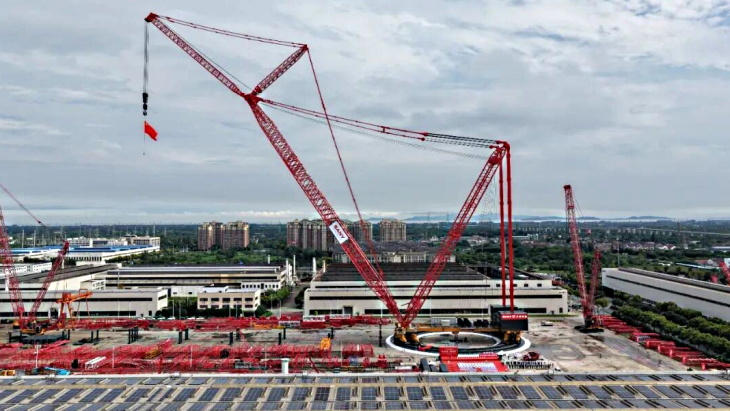
China’s giant crane for nuclear power plant construction
China General Nuclear (CGN) has unveiled a 250,000-tonne-metre lifting torque ring-rail crane designed to support construction of Hualong One 2.0 nuclear power plants. The crane combines 137-metre and 66-metre ultra-long booms and can reach a maximum height of 207 metres. Its developers say its lifting capacity at large operating radii is about 50% higher than comparable foreign equipment.
The fully electric crane can connect directly to a 10 kV industrial power supply, providing zero-emission and low-noise operation. Project calculations indicate that its use could shorten nuclear plant construction times by about 15%, reduce operating costs to around one-quarter of those of conventional oil-fired equipment, and cut site and logistics costs by approximately 20% and 30%, respectively.
The crane incorporates digital safety systems including intelligent anti-collision, 360-degree visual monitoring, remote fault diagnosis, cable-entanglement detection, facial recognition and work-behaviour recognition.
Developed by Sany Heavy Machinery and China Energy Engineering Guangdong Thermal Power Special Equipment, the crane is designed for Hualong One 2.0’s “one machine, two islands” concept, allowing one crane positioned between two reactor buildings to serve both units. CGN said it will first be used at Taipingling Phase III and subsequently at other Hualong One 2.0 projects.
Italy’s Senate approves a return to nuclear power
Italy’s Senate has approved a government bill paving the way for the country’s return to nuclear power after four decades. The bill passed by 81 votes to 51, with seven abstentions, following approval by the Chamber of Deputies in June. It gives the government powers to establish a regulatory framework for the reintroduction of “sustainable” nuclear energy within Italy’s decarbonisation and energy-security policies.
The legislation provides for a National Programme for Sustainable Nuclear Power, an independent Nuclear Safety Authority, stronger scientific and industrial research, development of specialised skills, and public information initiatives. The government says nuclear energy should be assessed alongside other technologies as part of efforts to reduce fossil-fuel dependence and support decarbonisation.
Several nuclear initiatives are already developing in Italy. EDF, Nuward, Edison and Italian industrial partners Ansaldo and Maire have expressed their ambition to deploy a first Nuward SMR in Italy by 2035. Newcleo is also developing lead-cooled fast-reactor technology and has significant operations in Italy.
Italy operated four nuclear power plants from the 1960s until a post-Chernobyl referendum led to the phase-out of nuclear power. The last two operating plants closed in 1990.