

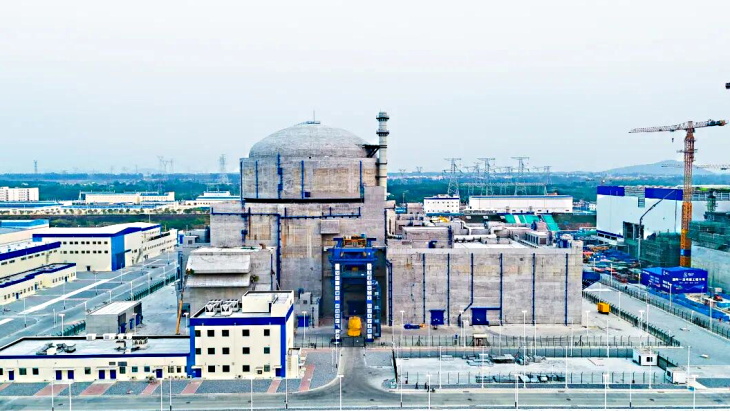
Third unit at Changjiang site commissioned
Unit 3 of the Changjiang nuclear power plant in China’s Hainan Province has entered commercial operation, becoming the first of two Hualong One (HPR1000) reactors under construction as Phase II of the site. Construction of Unit 3 began with first concrete in March 2021, while Unit 4 followed in December. The two-unit expansion represents an estimated investment of CNY40 billion (USD5.9 billion), with both units expected to be fully operational in early 2027.
Changjiang 3 achieved first criticality on 10 July 2026 and was connected to the grid on 1 August. The unit joins two CNP-600 pressurised water reactors, Changjiang 1 and 2, which entered commercial operation in 2015 and 2016. A demonstration ACP100 small modular reactor, also known as Linglong One, is also under construction at the site.
Once completed, Phase II is expected to generate 18 TWh of electricity annually, replacing more than 6.32 million tonnes of standard coal and avoiding about 11.6 million tonnes of CO₂ emissions each year. Changjiang 3 is the first large-scale reactor constructed and operated by China Huaneng Group as controlling stakeholder.
Deep Fission completes borehole demonstration
US company Deep Fission has completed a demonstration of the emplacement and retrieval system for its Gravity small modular reactor, which is designed to operate underground in a borehole approximately one mile (1.6 km) deep. On 3 September 2026, a full-scale, non-nuclear prototype of the reactor canister was lowered to a depth of 100 feet (30 m) inside an 86 cm-wide borehole, aligned and successfully retrieved.
The 20-foot (6 m) canister was handled using standard commercial drilling and rigging equipment operated by a commercial crew. Deep Fission said the demonstration did not require equipment specifically developed or adapted for nuclear applications, supporting the company’s approach of combining established technologies in a new deployment configuration.
The Gravity reactor is based on pressurised water reactor technology and is intended to be installed underground for enhanced protection and simplified deployment. The borehole test forms part of Deep Fission’s broader commercial validation programme, which also includes drilling, system integration, regulatory approval and eventual commercial operation.
IAEA’s projections suggest there could be 1,000 SMRs by 2060
The International Atomic Energy Agency (IAEA) has raised its nuclear capacity projections for the sixth consecutive year, forecasting in its high-case scenario that global nuclear capacity could reach 1,284 GWe by 2060, compared with 377.1 GWe at the end of 2025. The projection for 2050 has also increased to 1,045 GWe, from 992 GWe in last year’s forecast. In the low-case scenario, capacity would reach 696 GWe by 2060.
Small modular reactors (SMRs), defined by the IAEA as reactors of up to 300 MWe, are expected to account for 28% of new nuclear capacity in the high case and 23% in the low case. By 2060, this corresponds to 284 GWe of SMR capacity in the high case—equivalent to about 946 units averaging 300 MWe, or 1,136 units averaging 250 MWe. In the low case, 120 GWe would correspond to 400–480 SMRs.
The IAEA identifies supportive policies, investment, workforce development, regulatory cooperation and reactor lifetime extensions as key factors for achieving these projections.
UK Nuclear Startup Signs MOU On Technology To ‘Dramatically’ Speed Up Component Production
UK nuclear engineering startup Cambridge Atomworks has signed a memorandum of understanding with Cambridge Vacuum Engineering (CVE) to investigate the use of advanced electron beam welding for manufacturing critical components of its Odin microreactor. The collaboration will focus on CVE’s Ebflow technology, which the company says can significantly accelerate production of components such as reactor vessels and internals.
Odin was originally developed by US company Nano Nuclear Energy, which sold the design and associated intellectual property to Cambridge Atomworks in 2025. The microreactor is designed to fit inside standard shipping containers and provide reliable power for remote communities, disaster relief and off-grid industrial applications, including mining.
Odin is a low-pressure reactor using solid nuclear fuel and molten salt coolant. It is intended to be largely manufactured offsite and transported for deployment with minimal supporting infrastructure. Cambridge Atomworks is targeting an operational prototype by 2031. The agreement with CVE is intended to support development of the reactor’s supply chain and manufacturing strategy, with electron beam welding potentially reducing production times for key components.