

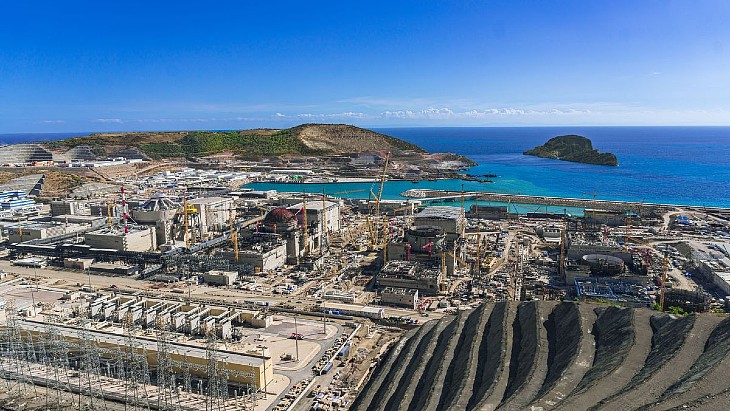
Akkuyu 1 fuel loading ‘could start next month’
Turkey’s first nuclear power plant, Akkuyu 1, is preparing for hot commissioning tests, which Rosatom hopes will be completed successfully in time for nuclear fuel loading to begin in December 2026. The tests will assess the reactor unit’s equipment and safety systems under normal operating conditions, using an external power source instead of nuclear fuel. Rosatom Director General Alexei Likhachev said he hopes the first electricity from the plant could be supplied to Turkey’s grid in January or February 2027.
The unit has also undergone a pre-start-up peer review by the World Association of Nuclear Operators (WANO). The review lasted more than two weeks and involved 17 experts from six countries. They assessed operating documentation, equipment condition, maintenance arrangements, staff training, emergency preparedness, fire and radiation protection, and engineering support.
Rosatom is building the Akkuyu plant in Mersin province under a build-own-operate model. The project comprises four VVER-1200 reactors with a total capacity of 4,800 MWe, expected to supply around 10% of Turkey’s electricity needs. Construction of the first unit began in 2018, and nuclear fuel was delivered to the site in April 2023.
Turkey is also pursuing plans for additional nuclear capacity. It is considering a second plant at Sinop and a third in the Thrace region, while discussions are under way with Canada and South Korea on potential projects. A recent agreement between AtkinsRéalis’s Candu Energy and Türkiye Nükleer Enerji Anonim Şirketi provides for a feasibility study for a potential 4.5 GW plant with up to six Candu reactors. Turkey is also targeting 5 GWe of small modular reactor capacity by 2050.
Norway Consortium Gets €1.8 Million Towards Development Of Nuclear Power For Maritime Industry
A Norwegian consortium has secured NOK 20 million (EUR 1.8 million) in government funding to develop an integrated nuclear propulsion system for commercial shipping. The project, Marine Nuclear Propulsion System (MarNuPS), is led by Emerald Nuclear Norway and includes shipbuilder Vard, offshore service vessel operator Island Offshore and several academic and engineering partners. Its objective is to advance maritime reactor technology from engineering studies to full-scale testing, with the first vessel deployment targeted for 2031 or 2032.
The first development phase, planned for 2027, will establish a test facility at Stette, near Ålesund. The partners will assemble and test a full-scale representation of the proposed propulsion system. No operating nuclear reactor will be used at this stage; instead, electric heating will simulate the reactor’s thermal output. This will allow engineers to assess the interaction between propulsion and power systems before introducing nuclear technology.
Testing will cover normal operating conditions, rapid changes in power demand, system performance under stress and crew interaction.
The concept is based on Emerald Nuclear’s 5 MW Gem microreactor, which uses gas-cooled reactor technology coupled with a supercritical carbon dioxide turbine to generate electricity. The integrated system will also feature energy storage, remote monitoring, power management and shipboard automation.
The first phase is estimated to cost NOK 150 million, with consortium members contributing substantial additional funding beyond the government grant. The project also involves the Norwegian University of Science and Technology, Imperial College London and engineering company Maskindynamikk.
Energy crisis reinforces comeback of nuclear power, says IEA
The International Energy Agency (IEA) expects the current global energy crisis, driven largely by the conflict in the Middle East and disruptions to shipping through the Strait of Hormuz, to further strengthen the role of nuclear power. In its latest World Energy Outlook 2026, the agency has revised its projections for nuclear energy upwards, identifying it alongside renewables, particularly solar photovoltaic power, as a major beneficiary of countries’ efforts to diversify energy supplies and reduce dependence on imported fuels.
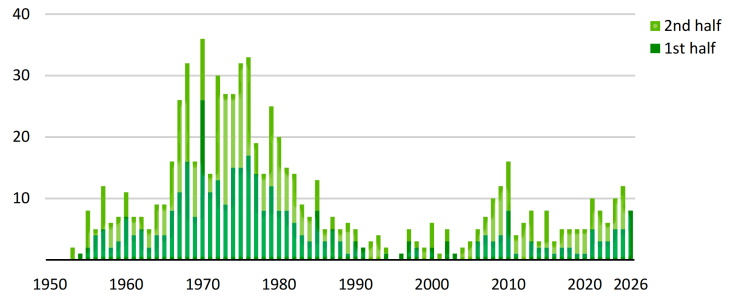
As of mid-2026, almost 90 GW of new nuclear capacity was under construction worldwide, the highest level in more than 35 years. More than 50 countries now have nuclear power plans or targets, including programmes involving small modular reactors (SMRs). The IEA also expects nuclear generation to grow faster than electricity demand in some scenarios, increasing its share of the global electricity mix from the current 9%.
The revised projections show substantial growth in installed nuclear capacity by 2050. Under the Current Policies Scenario, capacity is expected to reach 825 GWe, compared with 728 GWe in the 2025 outlook. Under the Stated Policies Scenario, it is projected to reach 886 GWe, while the Net Zero Emissions by 2050 Scenario envisages 1,203 GWe, up from 1,079 GWe previously.
The report highlights nuclear power’s contribution to energy security, noting that it can diversify national energy mixes, reduce exposure to market volatility and provide reliable electricity as electrification expands. Growing demand from artificial intelligence and data centres is also strengthening the case for dependable low-carbon power sources.
IEA Executive Director Fatih Birol stressed that the geopolitical crisis could have lasting consequences for global energy markets. He also warned countries against replacing one form of energy dependence with another. The World Nuclear Association welcomed the report, emphasising that nuclear energy has long contributed to decarbonisation and energy security and that achieving the projected growth will require sustained cooperation between governments, industry and investors.
Prototype aseismic bearing completed for Rolls-Royce SMR
Construction company Skanska has completed a prototype aseismic bearing pedestal for the Rolls-Royce small modular reactor (SMR). The component is part of the reactor’s seismic isolation system, which is installed beneath the nuclear island to protect the plant during earthquakes. By absorbing and dissipating seismic energy, the bearings reduce the forces transmitted from the ground to the reactor building, helping to preserve its structural integrity and functionality.
The demonstrator was manufactured and tested at Skanska’s Bentley Works facility in Doncaster, England. It successfully demonstrated the feasibility of producing the precast bearing pedestal off site in a controlled factory environment. The project is part of Rolls-Royce SMR’s strategy to test and validate critical construction methods and components before deploying them at future plants. Factory-based production is expected to improve quality control, production planning and construction predictability while reducing project risks.
The Rolls-Royce SMR is a 470 MWe pressurised water reactor designed for at least 60 years of operation. Approximately 90% of the plant, measuring around 16 metres by 4 metres, will be manufactured in factories, with on-site work largely limited to assembling prefabricated and pre-tested modules.
Rolls-Royce SMR is progressing deployment plans in the Czech Republic and the United Kingdom. In the Czech Republic, ČEZ has selected the technology for potential deployment of up to 3 GW of capacity, with the first unit planned near the Temelín nuclear power plant. In the UK, the government has selected Rolls-Royce SMR as its preferred technology for the country’s first SMR project. Three units are planned at Wylfa in North Wales, with a final investment decision expected in 2029.
France’s State Auditor Warns On Funding Problems For Six Planned EPR2 Nuclear Power Plants
France’s public audit body, the Cour des Comptes, has warned that state-owned utility EDF could face significant difficulties financing the construction of six planned EPR2 nuclear reactors. In a report published on 16 November, it highlighted the company’s substantial financial exposure across its long-term nuclear projects and warned that additional state support could be necessary if electricity market revenues fail to cover construction, maintenance and operating costs.
The six-reactor programme is estimated to cost EUR 72.8 billion in 2020 prices, equivalent to approximately EUR 84 billion in 2025 prices. The first units are expected to enter commercial operation from 2038. EDF is expected to take a final investment decision on the programme by the end of 2026.
The auditors warned that wholesale electricity prices falling below EUR 70/MWh would significantly increase EDF’s financing shortfall. Under certain scenarios, the French government could have to forgo approximately EUR 65 billion in cash profit distributions between 2026 and 2040 to ensure that EDF has sufficient funds to complete construction.
The report also highlighted the cost overruns at the Flamanville 3 EPR project, whose final cost reached EUR 23.7 billion in 2023 prices, compared with EDF’s original estimate of EUR 3.3 billion.
The six planned EPR2 reactors are to be built in three pairs at Penly, Gravelines and Bugey, all sites with existing nuclear facilities. Preparatory work has already begun at Penly and Gravelines. The auditors also stressed that extending the operating life of France’s existing reactors to 60 years remains the country’s least expensive low-carbon electricity option, provided safety requirements are met and maintenance costs are controlled.
France currently operates 56 commercial nuclear reactors, which generate approximately 70% of the country’s electricity.
Newcleo, Curio team up for recycled nuclear fuel supply
French advanced nuclear energy company Newcleo has entered into a collaboration with US nuclear recycling technology developer Curio to secure supplies of recycled used nuclear fuel and transuranic materials for the production of mixed-oxide (MOX) fuel. The materials are intended for Newcleo’s planned US fuel manufacturing facility and would eventually be used in its lead-cooled fast reactors (LFRs).
The agreement establishes a framework for evaluating commercial supply arrangements and joint research and development activities to advance used nuclear fuel recycling. Curio’s proprietary NuCycle technology is designed to recover valuable nuclear materials from used fuel while reducing the volume of residual waste by up to 97%. The recovered materials could provide a proliferation-resistant feedstock for MOX fuel production, reducing reliance on fresh uranium and limiting long-lived radioactive waste.
Newcleo CEO Stefano Buono said that securing reliable access to recycled nuclear materials is essential to reducing risks to the company’s future fuel supply. Curio CEO Edward McGinnis described the agreement as a step towards establishing a supply chain for advanced fast reactors.
Curio is also developing its NuCycle technology with support from the US Department of Energy, which awarded the company funding as part of a USD 19 million programme announced in February 2026. The work involves Idaho National Laboratory, Pacific Northwest National Laboratory and other technical partners, with the aim of preparing the technology for pilot-scale demonstration and eventual commercialisation.
Newcleo is separately progressing regulatory preparations for its planned US MOX fuel manufacturing facility and its first LFR-AS-200 reactor. In August, it submitted a Regulatory Engagement Plan to the US Nuclear Regulatory Commission, outlining the proposed pre-licensing discussions and key technical and regulatory issues.
The agreement comes amid renewed US interest in used nuclear fuel recycling. Although commercial reprocessing has been prohibited in the country since 1977, several government research programmes are now supporting the development of advanced recycling technologies.