

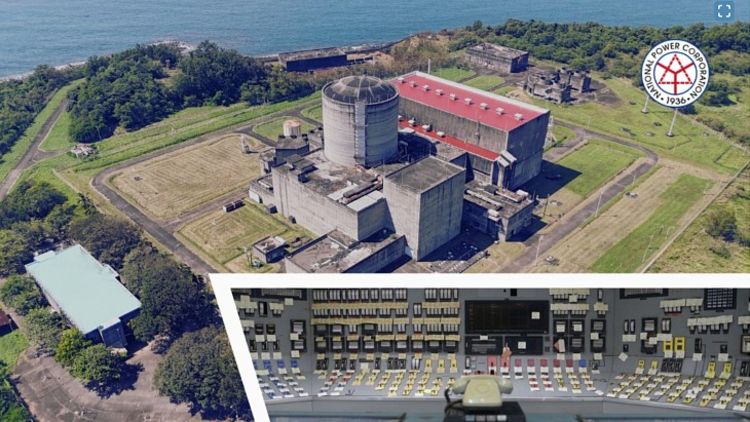
The mothballed nuclear power plant
The Philippines is considering refurbishing and commissioning the Bataan Nuclear Power Plant, a nearly completed facility that has remained out of operation for almost four decades. Originally planned as two 600 MWe units, the project was redesigned as a single 621 MWe Westinghouse reactor. Construction began in 1976 and was completed in 1984 at a cost of USD 1.9 billion. However, financial difficulties and concerns about earthquake safety, followed by the 1986 Chernobyl accident, led the government to abandon plans to operate the plant. It was never loaded with nuclear fuel.
Several assessments have since examined the possibility of restarting Bataan. An International Atomic Energy Agency mission in 2008 concluded that the plant could be refurbished and operated economically for 30 years, estimating the necessary investment at USD 800 million to 1 billion. More recent estimates have risen to USD 2.3 billion. In 2025, Korea Hydro & Nuclear Power (KHNP) began a two-phase technical and economic feasibility study, first assessing the plant’s current condition and then evaluating refurbishment options.
The renewed interest comes as the Philippines develops plans to introduce nuclear power, targeting 1.2 GW of capacity by 2032 and 4.8 GW by 2050. The Bataan plant is among the leading options under consideration. Its reactor design is similar to those used at Brazil’s Angra 1, Slovenia’s Krško and South Korea’s Kori 2, which have all operated for approximately 45 years.
A recent visit by participants of the World Nuclear Association’s World Nuclear Supply Chain conference offered an opportunity to assess the facility’s condition. Although the plant shows signs of ageing, it has been preserved through a long-term maintenance programme and is not an abandoned site. Visitors were able to inspect key areas, including the reactor vessel, steam generators, control room and turbine-generator hall. The visit reinforced the impression that refurbishment could be feasible and potentially less costly than building a new plant. However, the plant’s actual condition, safety upgrades and overall economics will need to be established through further technical assessments.
UK Nuclear Professionals Confident, But Warn Of Uncertainties And Challenges
A survey by the UK Nuclear Institute indicates that nuclear professionals are optimistic about the future of the country’s nuclear industry, while highlighting significant challenges that could hinder its growth. Almost four in five respondents (79.7%) expressed confidence in the industry’s prospects, with 33.3% describing themselves as very optimistic.
Despite this positive outlook, respondents raised concerns about the industry’s ability to translate its ambitions into successful project delivery. Key challenges include rising project costs, delays, workforce shortages, regulatory barriers and uncertainty over long-term government support. Particular concern was expressed about delivering major nuclear projects on schedule and within budget, as delays and cost increases could undermine confidence in the sector.
The survey also highlighted the need for greater certainty in government strategy and investment commitments, enabling companies to plan ahead, invest and expand their capabilities. Skills shortages and recruitment difficulties remain another concern, particularly in attracting and retaining experienced professionals. Some respondents also pointed to recruitment restrictions and staff reductions in certain organisations.
Further calls included more proportionate regulation, simpler administrative processes and greater innovation to accelerate project implementation.
Nuclear Institute Chief Executive Robert Gofton said that members’ optimism was encouraging, but stressed that the industry must have the necessary workforce, investment and institutional structures to achieve its ambitions. He emphasised the importance of developing the next generation of nuclear professionals, delivering major projects efficiently and ensuring long-term certainty for the sector.