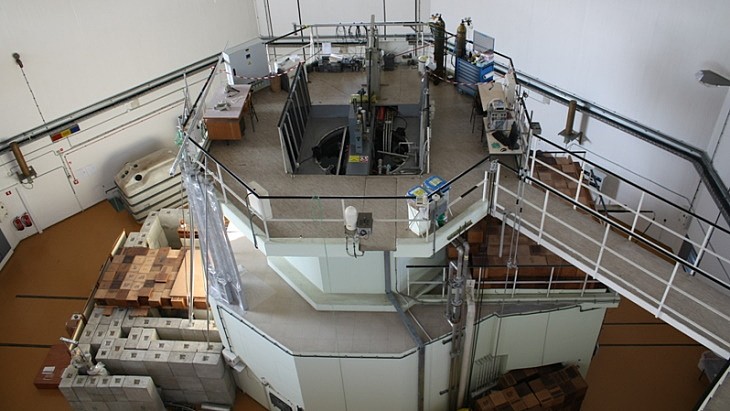

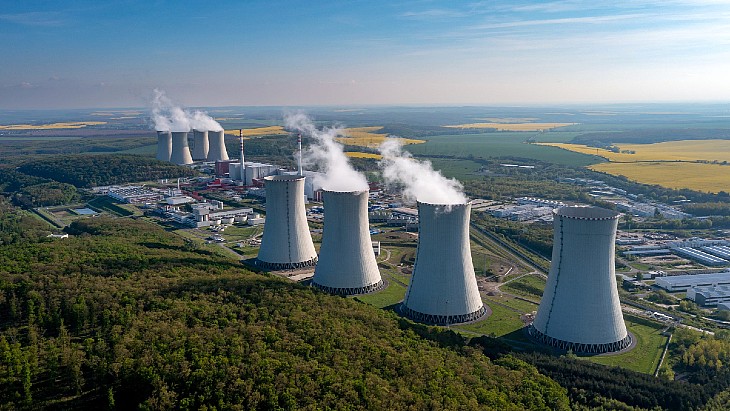
Mochovce 4 connected to the grid
Slovakia’s newest nuclear power unit, Mochovce 4, was connected to the electricity grid on 15 October 2026 and began supplying its first electricity at 20% power. The 471 MWe VVER-440 reactor is expected to generate electricity equivalent to approximately 13% of Slovakia’s current consumption. Its grid connection marks a major milestone in a project that has been under development for decades.
Construction of the first two units at the four-unit Mochovce plant began in 1982, while work on Units 3 and 4 started in 1986 before being suspended in 1992. Completion work resumed in 2009, with an estimated cost of EUR 6.7 billion. Mochovce 3 entered commercial operation in October 2023.
Mochovce 4 reached first criticality on 6 August 2026 and subsequently underwent commissioning tests. The initial grid connection was delayed by two days after an irregular response was detected in the voltage measurement circuits of the plant’s non-nuclear section, requiring some tests to be repeated.
Further testing will progressively increase the reactor’s output. The process includes connecting the second turbogenerator and culminates in a 144-hour continuous run at full power.
Slovakia already operates five nuclear reactors that generate more than 60% of its electricity. Mochovce 4 will further strengthen the country’s reliance on nuclear energy, while the government is also considering a new large reactor at Bohunice and the potential deployment of small modular reactors.
Westinghouse invests USD1 billion in US LEU+ fuel plant
Westinghouse has announced a USD 1 billion investment in a new nuclear fuel manufacturing facility at its Columbia Fuel Fabrication Facility in Hopkins, South Carolina. The plant will produce low-enriched uranium fuel with enrichment levels above 5% (LEU+) and is expected to begin operations in 2030. It will be the first new large-scale nuclear fuel factory built in the USA in more than 50 years.
LEU+ fuel has a higher uranium-235 content than the 3–5% enrichment typically used in commercial reactors. Its deployment could enable power uprates at existing nuclear plants, increase electricity generation and extend operating cycles, potentially reducing operating costs. In 2025, fuel assemblies containing Westinghouse’s LEU+ ADOPT fuel were loaded into Unit 2 of the Vogtle nuclear power plant in the first commercial US deployment of this type of fuel.
The new facility will occupy a purpose-built building adjacent to the existing plant, which dates from 1968 and employs more than 1,200 people. It will use advanced automation and an innovative dry manufacturing process similar to that employed at Westinghouse’s UK facility.
The investment supports the US Department of Energy’s UPRISE programme, which aims to add 5 GW of nuclear capacity to the existing fleet by 2029. Westinghouse estimates the project will generate USD 4.9 billion in economic benefits across South Carolina over the next decade, including USD 3.8 billion in Richland County.
Finland Grants Operating Licence To World’s First Deep Geologic Nuclear Repository
Finland has granted Posiva an operating licence for its spent nuclear fuel encapsulation and final disposal facility at Olkiluoto, making it the first deep geological repository for spent nuclear fuel anywhere in the world to receive such a licence. However, disposal operations cannot begin immediately. Posiva must complete the remaining commissioning tests and inspections, with verification and approval by Finland’s Radiation and Nuclear Safety Authority (Stuk) required before operations start. No detailed timetable has been announced.
The Onkalo facility in Eurajoki, western Finland, comprises an above-ground encapsulation plant and an underground repository excavated approximately 430 metres into bedrock. It is designed to accommodate spent nuclear fuel from the Olkiluoto and Loviisa nuclear power plants. The fuel will be sealed in disposal canisters and placed in deposition holes surrounded by bentonite clay, with the bedrock providing an additional protective barrier.
The licence permits the disposal of up to 6,500 tonnes of uranium in spent fuel, equivalent to approximately 3,300 canisters, with a maximum of 60 canisters per year. The facility is expected to operate for more than 100 years, with disposal activities continuing until the 2120s, when the repository is planned to be backfilled and closed.
Jointly owned by Finland’s nuclear power producers TVO (60%) and Fortum (40%), Posiva submitted its licence application in December 2021 after decades of research and development.
Viewpoint: Four million workers won’t be enough without the right leaders
The global ambition to triple nuclear energy capacity will require not only a larger workforce but also a new generation of leaders capable of managing complex projects, strengthening safety culture and coordinating international cooperation. According to the International Atomic Energy Agency (IAEA), four million nuclear professionals will be needed by 2050. With 39 countries having endorsed the Declaration to Triple Nuclear Energy, leadership development is becoming a critical priority across the sector.
Leadership challenges extend beyond plant operations and new construction to regulation, financing, supply chains and the long-term operation of existing reactors. Countries introducing nuclear power must establish effective institutions and independent regulators, while established nuclear programmes face ageing infrastructure, major refurbishment projects and the loss of experienced personnel. Around a quarter of the nuclear workforce was over 55 in 2022, highlighting the urgency of transferring knowledge to younger professionals.
The World Nuclear University (WNU) Summer Institute aims to address these challenges by bringing together promising mid-career professionals from operators, regulators, suppliers, research organisations and governments. Its five-week programme combines expert presentations, mentoring, international teamwork on real industry projects and visits to nuclear facilities. More than 1,700 Fellows from over 90 countries have participated to date.
The 2027 programme will take place in Cape Town, South Africa, from 30 May to 3 July, marking its first edition in Africa. The location offers insight into a country operating its existing Koeberg reactors while planning 5,200 MWe of new nuclear capacity by 2039. Applications close on 27 November 2026. The article stresses that preparing capable leaders today is essential to delivering the nuclear expansion planned for the coming decades.
Slovenia’s deep borehole disposal options studied
A cost assessment by US company Deep Isolation for Slovenia’s Agency for Radioactive Waste Management (ARAO) has found that disposing of spent fuel from the TRIGA II research reactor together with spent nuclear fuel from the Krško Nuclear Power Plant would be more economical than constructing a separate disposal facility. Integrating the research reactor’s small fuel inventory into a repository for Krško would add only marginal costs, as most expenditure would be associated with fixed facility infrastructure.
A standalone deep borehole repository for TRIGA II spent fuel was estimated to cost EUR 65.6 million (USD 73.5 million), excluding contingencies and VAT. The reactor, operated since the 1960s at the Jožef Stefan Institute, produces radioactive isotopes for medical research and supports training. It is scheduled to shut down in 2043. Its inventory comprises 84 fuel elements, which could potentially fit into a single universal canister.
The study examined alternative borehole designs, including a vertical borehole extending to a depth of 1.5 km and a horizontal microrepository using smaller, specially designed canisters. Deep Isolation concluded that integrating the fuel into the Krško disposal programme would be the most cost-effective option, without significant additional safety or scheduling impacts. Further work would be needed on safety assessments, implementation planning and regulatory engagement.
Deep borehole disposal involves placing corrosion-resistant canisters in deep geological formations using drilling technology adapted from the oil and gas industry. Although the concept has been studied internationally for decades, it has not yet been implemented.