

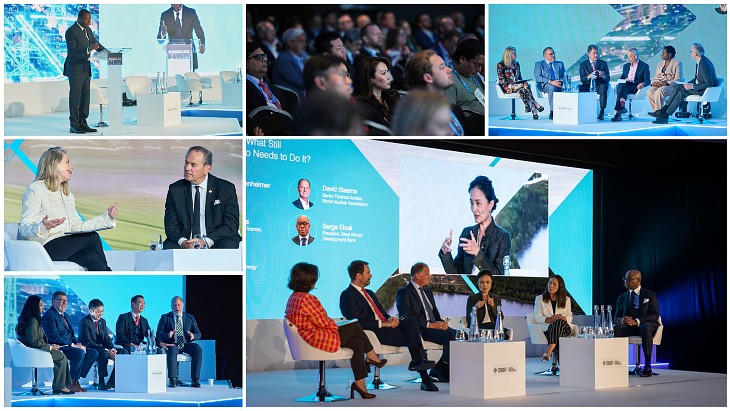
Podcast: World Nuclear Symposium 2026
More than 1,300 participants from 65 countries gathered in London in September for the 2026 World Nuclear Symposium. This podcast from World Nuclear News highlights key discussions and speeches on the future of nuclear energy.
Industry leaders, investors, policymakers and technology experts examine the growing role of nuclear power in meeting global energy demand. Topics include nuclear investment and financing, uranium supply, nuclear fuel markets, enrichment technologies and the development of advanced nuclear technologies. Speakers from major companies and organisations, including Cameco, Kazatomprom, Google, Orano and Rosatom, share their perspectives on the opportunities and challenges facing the sector.
The discussions also address nuclear fuel security, international cooperation, sustainability and the potential expansion of nuclear applications, including maritime transport. Contributions from government representatives and regulatory experts highlight the importance of effective regulation and supportive policy frameworks.
The podcast provides an overview of the priorities shaping the global nuclear industry, from securing reliable fuel supplies and financing new projects to strengthening international partnerships and supporting nuclear energy’s role in the clean energy transition.
Hyundai E&C tests used fuel repository excavation equipment
South Korea’s Hyundai Engineering & Construction (Hyundai E&C) has successfully tested specialised equipment designed to excavate full-scale deposition holes for the geological disposal of used nuclear fuel. The demonstration was conducted in bedrock inside an underground research tunnel as part of a government-funded research and development programme led by the Korea Radioactive Waste Agency (KORAD).
The equipment, measuring 1.75 metres in diameter and 5.7 metres in length, was developed for the Korea Advanced Disposal System (KORADIS), which is adapted to the country’s geological and technical conditions. Its foldable cutterhead allows the equipment to be retrieved safely after excavation and reused to construct multiple deposition holes.
During the demonstration, artificial intelligence was used to analyse excavation data in real time and optimise operations according to ground conditions. After excavation, LiDAR-based digital mapping verified the hole’s dimensions and construction quality.
Hyundai E&C is also developing specialised concrete and grout for engineered barriers, groundwater-control technologies, and digital systems for rock classification and monitoring.
South Korea currently stores used nuclear fuel at individual nuclear power plant sites, many of which are approaching capacity. Legislation adopted in February 2025 establishes targets for interim storage facilities for high-level radioactive waste by 2050 and permanent disposal facilities by 2060.
Agreement signed on second Polish nuclear power plant
Poland’s Ministry of Energy, Polskie Elektrownie Jądrowe (PEJ) and state-owned utility Polska Grupa Energetyczna (PGE) have signed an agreement defining their roles in preparing the country’s second nuclear power plant. Under the agreement, PEJ will act as investor and project coordinator, while PGE will conduct site analyses and preliminary feasibility studies in cooperation with potential technology suppliers. The agreement reflects Poland’s updated nuclear power programme, adopted by the government on 29 September 2026.
Bełchatów and Konin are the preferred locations for the second plant. A competitive dialogue involving companies from the USA, France and Canada is under way to select a technology provider and project contractor. The process will assess proposals covering reactor technology, investment financing and broader strategic cooperation. Poland is considering large Generation III+ light-water reactors.
Under the revised schedule, a strategic partner and technology are to be selected in 2027, construction is expected to begin around 2032, and the first unit is planned to enter operation around 2040. The final investment decision will depend on further studies confirming the project’s feasibility.
Poland’s first nuclear power plant is planned for Lubiatowo-Kopalino in northern Poland, where three Westinghouse AP1000 reactors with a combined capacity of 3,750 MWe are planned. Construction is scheduled to begin in 2028, with the first unit expected to start commercial operation in 2036.