

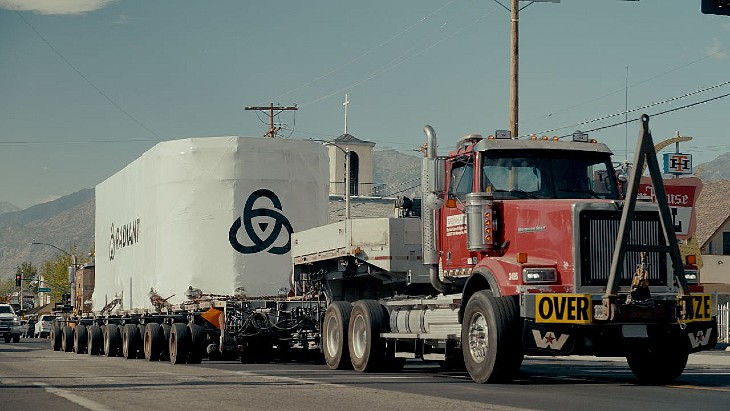
Kaleidos microreactor begins journey to Idaho
Radiant’s 1 MWe Kaleidos microreactor has begun a more than 1,000-mile journey from California to Idaho National Laboratory (INL), demonstrating its design for transport by land, sea and air. The reactor will undergo a five-phase testing programme at INL’s DOME facility, progressing from zero-power criticality to full heat and power generation and culminating in a 150-hour continuous run without operator intervention. Radiant said the unit is identical in design, scale and fuel load to the commercial reactors it plans to manufacture at its R-50 facility in Oak Ridge, Tennessee. At DOME, Kaleidos will be loaded with TRISO fuel under US Department of Energy and INL supervision. Data from the programme will support Radiant’s Nuclear Regulatory Commission licensing process and commercial deployment plans. The testing campaign is expected to conclude in the third quarter of 2026. Radiant also plans to deliver its first commercial Kaleidos microreactor to Buckley Space Force Base by 2028.
Government approves extended operation of Almaraz plant
The Spanish government has approved the extension of the operating licences for both units of the Almaraz nuclear power plant until June 2030. Under Spain’s nuclear phase-out plan, Almaraz 1 had previously been scheduled to close in October 2027 and unit 2 in October 2028. The Nuclear Safety Council concluded that the plant meets the requirements for safe operation until 2030. The government cited uncertainty in international energy markets, geopolitical conflicts and the need to limit consumers’ exposure to potential energy price increases as reasons for the temporary extension. It stressed that the decision does not change Spain’s overall plan to phase out nuclear power by 2035. The nuclear industry welcomed the extension, highlighting the plant’s contribution to energy security, grid stability and low-carbon electricity generation. Almaraz’s two pressurised water reactors provide more than 7% of Spain’s electricity, equivalent to the consumption of around four million households, and the plant supports approximately 4,000 jobs.
China Completes First Fuel Loading At Tianwan-7 Nuclear Plant
The first loading of nuclear fuel has been completed at Unit 7 of China’s Tianwan nuclear power plant, marking a key step towards commissioning of the new reactor. A total of 163 fuel assemblies were loaded between 12 and 18 August 2026. The unit will now undergo preparations for first criticality, grid connection and electricity generation, with commercial operation scheduled to begin later this year. Tianwan 7 is the first Russian-supplied Generation III+ VVER-1200 pressurised water reactor in China to reach the fuel-loading stage. Construction began in May 2021, while its sister unit, Tianwan 8, has been under construction since February 2022. The Tianwan site already operates six reactors based on Russian VVER-1000 and Chinese CNP-1000 designs. Once all eight units are operational, the plant is expected to generate about 70 TWh of electricity annually. China currently has 60 nuclear reactors in commercial operation and 37 units under construction, more than any other country.
Detritiation facility reopens at Culham
The UK Atomic Energy Authority (UKAEA) has restarted its Materials Detritiation Facility (MDF) at the Culham Campus following a year-long upgrade. The facility will support research into materials removed from the retired Joint European Torus (JET) fusion experiment, where residual tritium accumulated in reactor walls and internal components during deuterium-tritium operations. The MDF uses controlled thermal treatment to release retained tritium from materials including tungsten, beryllium, steel, copper and carbon-fibre composites. Removing tritium can allow materials initially classified as intermediate-level radioactive waste to be reclassified as low-level waste or potentially recycled, significantly reducing disposal costs. Tests have demonstrated that complete components and mixed material streams can be processed simultaneously, supporting the development of future industrial-scale treatment methods. The research will provide data for JET’s decommissioning and waste management strategy and could also inform approaches for future fusion facilities. JET’s decommissioning and repurposing programme is expected to continue until around 2040.
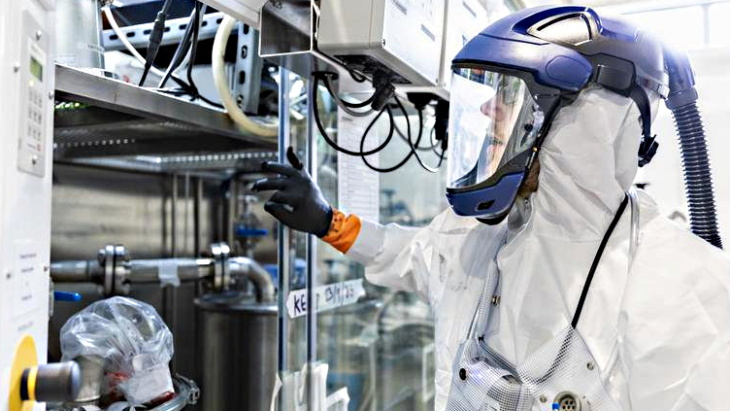
Regulatory approval for expansion of Chernobyl waste facility
Ukraine’s State Nuclear Regulatory Inspectorate has approved the construction of a new near-surface repository at the Buriakivka radioactive waste disposal facility within the Chernobyl Exclusion Zone. The new trench-type repository, designated No. 11A, will expand capacity for low- and intermediate-level radioactive waste generated by the clean-up and decommissioning of the Chernobyl nuclear power plant. Buriakivka has operated since 1987 and has received about 636,000 cubic metres of Chernobyl-related radioactive waste in 31 surface disposal trenches. Following a nuclear and radiation safety review, the regulator concluded that the proposed design meets applicable safety requirements and that operator CERWM has the necessary capability to undertake construction. The regulator recommended that safety assessments continue to be updated as construction progresses and actual waste characteristics become clearer. Once commissioned, the new repository will support continued disposal of low-level radioactive waste from Chernobyl decommissioning activities as well as waste generated by other organisations operating in Ukraine’s nuclear sector.
New UK ‘Immersive Facility’ Helps Nuclear Specialists Plan Decommissioning Projects
A new immersive digital facility has opened at the Robotics and Artificial Intelligence Collaboration centre (RAICo1) in Whitehaven, northwest England, to support safer and more efficient nuclear decommissioning. Developed by AtkinsRéalis in partnership with Sellafield Ltd and Igloo Vision, the facility combines remotely operated robotic systems, live data streaming and advanced visualisation in a 360-degree interactive environment. It allows up to ten engineers, operators and project specialists to explore digital representations of nuclear facilities, rehearse activities and assess changing site conditions before carrying out work in hazardous areas. The technology is expected to reduce time spent in such environments by up to 40%. The facility forms part of Sellafield’s wider strategy to integrate robotics, artificial intelligence, digital twins and modelling technologies into decommissioning activities. RAICo1 was established in 2022 by Sellafield Ltd and the UK Nuclear Decommissioning Authority to develop remote and autonomous technologies aimed at accelerating complex nuclear clean-up and decommissioning projects.
Atomic Canyon launches virtual assistant for US nuclear fleet
Atomic Canyon has launched NIVA, the Nuclear Industry Virtual Assistant, an artificial intelligence platform designed for commercial nuclear power plants across the United States. Developed with input from organisations including INPO, EPRI and the Nuclear Energy Institute, NIVA helps nuclear professionals access and apply information contained in technical, regulatory and operational records. The platform currently includes a Knowledge Assistant for answering natural-language questions using industry documentation and an Operating Experience Assistant that identifies relevant operating experience based on context rather than keywords. A troubleshooting tool is also under development. NIVA uses Atomic Canyon’s FERMI nuclear-specific AI models, trained on more than 53 million pages of US Nuclear Regulatory Commission data in collaboration with Oak Ridge National Laboratory. Following a six-month industry pilot involving operators including Constellation Energy, Atomic Canyon says the launch represents a shift from experimental AI applications towards routine operational use across the US nuclear fleet, supporting knowledge transfer, workforce efficiency and access to decades of industry experience.