

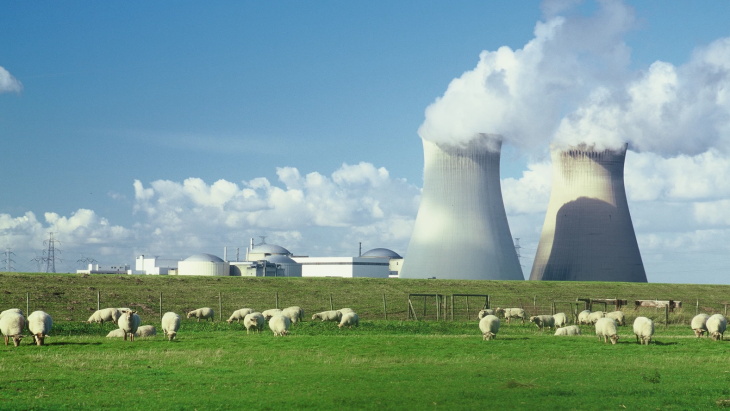
Fifth Belgian reactor is permanently shut down
Unit 2 of the Doel nuclear power plant in Belgium’s Flanders region has been taken offline for the final time after 50 years of operation and disconnected from the grid. Its closure is in line with Belgium’s nuclear phase-out policy, under which four other reactors have already been shut down.
Belgium’s federal law of 31 January 2003 required the phase-out of all seven nuclear power reactors in the country. Under that policy, Doel 1 and 2 were originally set to be taken out of service on their 40th anniversaries, in 2015. However, the law was amended in 2013 and 2015 to provide for Doel 1 and 2 to remain operational for an additional 10 years. Doel 1 was retired in February this year. Duel 3 was closed in September 2022 and Tihange 2 at the end of January 2023. Tihange 1 was disconnected from the grid on 30 September this year.
Belgium’s last two reactors – Doel 4 and Tihange 3 – had also been scheduled to close last month. However, following the start of the Russia-Ukraine conflict in February 2022 the government and Electrabel began negotiating the feasibility and terms for the operation of the reactors for a further ten years, to 2035, with a final agreement reached in December, with a balanced risk allocation.
Restart of two Taiwanese plants feasible, ministry says
Taiwan’s Ministry of Economic Affairs has approved Taipower’s report on the current condition of its decommissioned nuclear power plants, which concludes that the Kuosheng and Maanshan plants are “feasible for reoperation”. The utility is expected to submit plans next year for their restarts.
Taiwan Power Company (Taipower) conducted the current status assessment of the Chinshan, Kuosheng and Maanshan nuclear power plants in accordance with the newly revised Nuclear Regulation Act and its regulations, conducting an inventory and analysis of seven major aspects, including unit equipment, manpower allocation, dry fuel storage, service life extension of similar units, geological seismic resistance, current status of safety inspections and preparations, and power supply efficiency.
The assessment determined that the two-unit Chinshan plant – Taiwan’s oldest plant – is not feasible for reoperation. The two 604 MWe boiling water reactors (BWRs) were shut down in December 2018 and July 2019, respectively, following the expiration of their operating licences after 40 years of operation.
Nuclear Reactors For Container Ships Could Eliminate Operating Costs Of $68 Million
Manufactured nuclear propulsion units for container ships could reach commercial readiness within four years of starting an intensive deployment programme, with the potential to eliminate operating costs of up to $68m (€58m) annually, according to a new report.
Small modular reactors (SMRs) for nuclear-powered vessels could be produced for $750-1,000 per kW, significantly cheaper than conventional nuclear power plants, and maintained within standard vessel drydock maintenance cycles.
For vessel operators, nuclear-powered vessels could eliminate their largest operating costs – up to $50m annually in fuel and an estimated $18m in carbon penalties.
Nuclear vessels would also cut greenhouse gas emissions and deliver faster transit times, while maintaining safety and economic competitiveness.
The findings are drawn from a new Lloyd’s Register and LucidCatalyst report for Seaspan Corporation, a Singapore-based marine services company. The report examines the technical, economic, and regulatory potential of integrating SMRs into the containership fleet. LucidCatalyst performed a comprehensive analysis of the costs and benefits for Seaspan’s business model and collaboratively developed requirements that, if met, would create significant value.
Neighbouring countries consulted on Norwegian nuclear power plant
The Norwegian Environment Agency is sending a proposal for a study programme for a nuclear power plant in Aure and Heim municipalities for consultation to neighbouring countries, as required by the Espoo Convention.
Adopted in 1991 in the Finnish city of Espoo and entered into force on 10 September 1997, the Espoo Convention sets out the obligations of signatory parties to assess the environmental impact of certain activities and in doing so, notify and consult other parties on all major projects where the project under consideration is likely to have a significant adverse environmental impact in that state.
Nuclear project developer Norsk Kjernekraft submitted a proposal to Norway’s Ministry of Energy in November 2023 for an assessment of the construction of the small modular reactor (SMR) plant. According to the preliminary plan, the plant will be located in a common industrial area – the Taftøy industrial park – in the border area between Aure and Heim. The plant is planned to consist of several SMRs, which together will produce around 12.5 TWh of electricity annually, if the plant is realised in its entirety.
In April this year, the Ministry of Energy, the Ministry of Health and Care Services, the Ministry of Justice and Public Security, and the Ministry of Climate and Environment requested the Norwegian Water Resources and Energy Directorate, the Norwegian Radiation and Nuclear Safety Authority, and the Norwegian Directorate for Civil Protection prepare an Environmental Impact Assessment programme for the proposed plant. A notification with a proposal for an assessment programme for the establishment of a nuclear power plant in Aure and Heim municipalities was published for consultation in Norway by the Ministry of Energy in May 2024 with a deadline for submissions that same autumn.
Conceptual design completed for Japan’s FAST fusion demo project
The Fusion by Advanced Superconducting Tokamak project, designed to demonstrate fusion energy power generation in Japan in the 2030s, has reached its first key milestone, Starlight Engine and Kyoto Fusioneering have announced.
The Conceptual Design Report has been put together in the year since the project’s launch in November 2024, and involved the two companies and researchers and experts from a number of Japanese universities and public institutions, as well as support from a number of other Japanese companies.
The Fusion by Advanced Superconducting Tokamak (FAST) device, to be sited in Japan, aims to generate and sustain a plasma of deuterium-tritium (D-T) reactions, demonstrating an integrated fusion energy system that combines energy conversion including electricity generation and fuel technologies. The project will employ a tokamak configuration, chosen for its well-established data and scalability.
Targeting a power generation demonstration by the end of the 2030s, FAST will address remaining technical challenges en route to commercial fusion power plants. The FAST Project Office notes that power generation refers to producing energy from fusion reactions, but does not imply net positive power production where electricity output exceeds electricity consumption.