

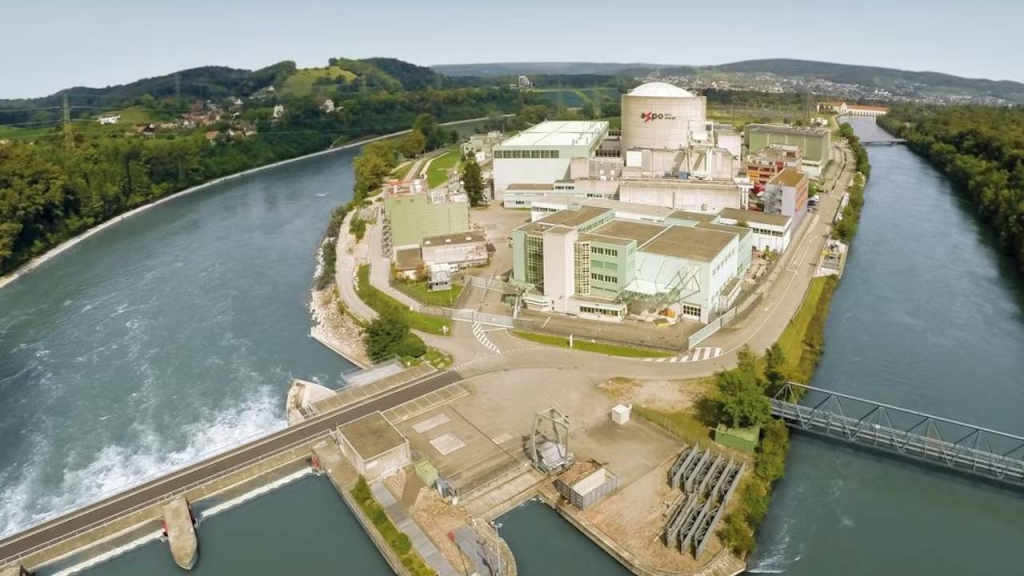
Swiss Senate Committee Votes In Favour Of Ending Ban On New Nuclear Plants
Allowing reactors to be built would mark major shift in Switzerland’s energy policy
A Swiss Senate committee has voted in favour of lifting the existing ban on licences for the construction of new nuclear power plants, parliamentary services said on 20 January.
Following the 10-2 vote by the environment, spatial planning and energy committee, the Senate expected to deal with the topic in the spring.
A technology-neutral energy policy should ensure sufficient domestic production capacities for “a secure and cost-effective power supply at all times”, a press release said. The possibility of building new nuclear power plants will “expand the room for manoeuvre for future energy supply”.
According to the committee, given the “considerable” increase in electricity consumption, security of supply planning must be open to different technologies if sufficient domestic generation capacity is to be developed over the coming decades and dependence on imports reduced.
“The objective is to ensure a secure and sustainable electricity supply, if necessary by resorting to new nuclear power plants,” the press release said.
In August the Swiss government presented draft legislation to end its ban on building new commercial nuclear power plants, reversing its existing policy, adopted after a 2017 referendum, to phase out the technology.
The plan would allow companies to apply for licences to build reactors – if approved by parliament and upheld in a potential referendum.
South Korea Announces Plans For Two New Large-Scale Nuclear Plants
State-owned KHNP to begin search for suitable sites with first SMR also in pipeline
South Korea has said it will build two large-scale nuclear power plants by 2038 with work expected to begin soon on finding a site.
Reports in South Korea said state-owned Korea Hydro & Nuclear Power (KHNP) plans to open bidding for sites for the new reactors, followed by an evaluation and site selection process expected to take five to six months.
The company is targeting construction permits in the early 2030s and completion of the reactors in 2037 and 2038.
Climate minister Kim Sung-whan said on 26 January that the government would continue the construction of the new nuclear power plants as scheduled under the 11th Basic Plan for Electricity Supply and Demand.
The plan, devised by the previous government and finalised in February 2025, outlined national electricity supply policy for 2024-2038. It included the construction of two new large-scale reactors between 2037 and 2038 and deployment of the country’s first commercial small modular reactor (SMR) in 2035.
South Korean media said the construction of the two new large-scale plants had been put on hold for a “public consensus process” when Lee Jae Myung became president in June last year.
The English-language Korea JoonAng Daily said public opinion polls commissioned by the government have since showed that an average of 80% of respondents said nuclear power is needed, with 60% supporting the additional construction plan.
Denmark begins study on potential use of nuclear energy
A framework is now in place for investigating the “potential and risks” of new nuclear technologies – including small modular reactors – and the lifting of a moratorium on nuclear power, Denmark’s Ministry of Climate, Energy and Utilities has announced.
In 1985, the Danish parliament passed a resolution that nuclear power plants would not be built in the country. However, in a parliamentary vote in May last year, two-thirds of Danish MPs supported the country launching an investigation into the possible use of nuclear power to enhance its energy security. The analysis is aimed at allowing a subsequent debate on the possible lifting of the ban on nuclear power to take place on an informed basis.
“Although the government does not consider conventional nuclear power to be relevant in Denmark, there has been increasing interest in new nuclear power technologies such as small modular reactors (SMRs) in Denmark and the EU in recent years,” the ministry noted. “This should be seen, among other things, in light of the ongoing development of SMR solutions, increased focus on ensuring balance in a fossil-free energy system with a view to increased focus on European energy independence, stable and low energy prices, stable electricity supply and increased business interest.”
The ministry has now said that the basis for the analysis of new nuclear power technologies is in place and that initial work on the analysis has begun.
The analysis aims to uncover the following: whether SMRs could be included in the Danish energy system, including in relation to economic costs and benefits; the need for new national regulation, authority structure and competencies relevant to the possible establishment of nuclear plants in Denmark, as well as a specific work plan for how and in what sequence identified needs can be handled in order to constitute a sufficient basis for such plants to be established, and for what decisions must be taken if it is politically desired to lift the ban; and commercial interests and potential for the development and supply of components for SMRs, as well as for larger commercial enterprises in Denmark as potential buyers of electricity and/or heat from SMRs.
The analysis will also include an immediate estimation of a range of expected resource needs and considerations regarding authority organisation and departmental responsibility across the state in the event of a lifting of the ban and the development, testing and establishment of SMRs in Denmark. This will also include an immediate estimation of the need for new full-time equivalents in state authorities.
“The analysis does not in itself result in the launch of new initiatives with a view to the establishment of new nuclear power technologies in Denmark, but could form the basis for a discussion on this,” the ministry said.
“Green energy from the sun and wind is now and will continue to be the backbone of the Danish energy supply, but we can also see that it cannot stand alone,” said Minister for Climate, Energy and Utilities Lars Aagaard. “Therefore, we must be open to whether other technologies can provide us with green energy in the future. Small modular nuclear reactors may be an option here. However, mass-produced SMRs are neither a quick fix nor a free pass, and we must have a basis for getting control of the regulatory processes, safety, waste, competencies and responsibility. With this analysis, we will have a solid, informed basis on which to make political decisions.”
He added: “I approach nuclear power with an open mind, and I hope that everyone’s pulse will slow down. Debating the lifting of a ban without considering whether you will also do everything else that comes with it just sends a signal without substance. There may be great potential in SMRs down the road, so it should not be about ideology, but about doing things thoroughly and in the right order.”
The analysis is expected to be completed in the second quarter of 2026.
In December, several Danish business organisations, universities and companies launched the Nuclear Power Alliance with the aim of advocating for a technology-neutral approach to nuclear power in the country. The alliance is led by, among others, the Confederation of Danish Industry, Dansk Metal and the Novo Nordisk Foundation. Its members also include chemical engineering firm Topsoe and engineering consultancy Niras, as well as the private equity fund 92 Capital, which concentrates its investments in the nuclear energy sector