

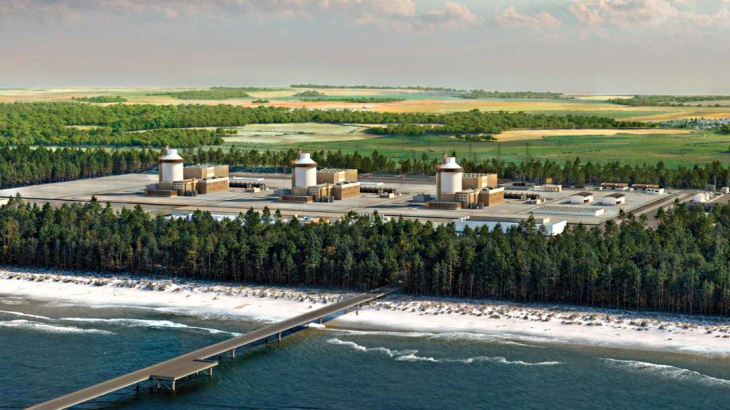
Europe Approves State Aid For Poland Nuclear Station, First Concrete Planned For 2028
The European Commission has given its approval for Poland to finance its first commercial nuclear power station with public aid estimated at PLN 60 billion (€14.2bn, $16.5bn).
The commission said in a statement on 9 December that the nuclear station, which will have three Westinghouse AP1000 reactor units, is scheduled to start operating in the second half of the 2030s.
Funding For Fusion Energy Jumped By 30% From June-Sept, With US And China Dominating
Cumulative investment in fusion energy jumped by 30% between June and September to €13bn ($15.1bn) from €9.9bn, with the US and China dominating the landscape, according to a report by the European Union’s F4E Fusion Observatory.
Data from the Observatory showed the US as clear leader in the fusion energy space, taking 53% of global funding, or €6.9bn, with China holding a 34% share of investments at €4.4bn. Some way behind, lies the EU with a global share of roughly 5% of global funding, with Germany accounting for 85% of that capital.
This divergence was also creating a rise of “fusion unicorns”, the report said, with four companies in the US and China – Commonwealth Fusion Systems, China Fusion Energy Co, NEO Fusion and TAE Technologies – all exceeding €1bn in global private investment.
Turkish Defence Company Prepares To Enter Nuclear Energy Sector
Turkish defence company Baykar, best known for the production of drones, is preparing to step into the nuclear energy sector with the development of a small modular reactor (SMR), according to energy and natural resources minister Alparslan Bayraktar.
Baykar is reported to be working on a 40-MW SMR unit, which would have the capacity to power more than 100,000 households on its own, Bayraktar told local media.
The move comes as Ankara prepares a comprehensive legislative package to regulate the nuclear energy industry. Turkey aims to reach 7.2 GW of nuclear capacity by 2035 and 20 GW by 2050.
Deep Fission To Break Ground On Underground Advanced Reactor Pilot Project In Kansas
Deep Fission, the nuclear energy company placing small modular pressurised water reactors in boreholes one mile underground, has selected the Great Plains Industrial Park in Kansas as the site of its advanced reactor pilot project.
The California-headquartered company, founded in 2023, said it will hold a groundbreaking ceremony on 9 December, marking a significant milestone in its first demonstration of the Gravity nuclear plant.
Deep Fission plans to deploy 15-MW pressurised water reactors one mile underground via 30-inch boreholes. Its reactor was previously referred to as the Deep Fission Borehole Reactor-1, or DFBR-1, but was recently renamed by the company to the Gravity Nuclear Reactor, or simply Gravity.
Podcast: What happened with nuclear energy at COP30?
What was achieved at COP30 – the 30th UN Climate Change Conference, held in Belém, Brazil – and what role did nuclear energy play? Here’s an assessment from Jonathan Cobb, World Nuclear Association Senior Programme Lead, Climate.
Also in this episode – you can listen using the link above – Thomas Lamb from Myriad Uranium talks about the Copper Mountain project, the general outlook for future uranium demand and supply, and the potential benefits of artificial intelligence.
Flamanville EPR reaches full power
The Flamanville 3 reactor has reached full power for the first time, after the Autorité de Sûreté Nucléaire et de Radioprotection gave approval on Friday for it to move beyond 80% of its nominal power as part of its commissioning process.
The ramp-up of nuclear thermal power reached 100% at 11:37 on Sunday, EDF said.
It added: “Reaching the 100% mark for the first time enables testing of equipment at full power, taking of measurements and verifying that everything is functioning properly. Over the coming weeks, and as part of the start-up programme, the power of the reactor will vary to continue testing at different power levels and an operation will be carried out on an internal electrical substation. This milestone reflects the commitment and expertise of the teams of EDF and of its industrial partners over the past months to ensure the safe start-up of the reactor.”
This is the latest stage of commissioning the 1650 MWe (gross) pressurised water reactor. The Autorité de Sûreté Nucléaire et de Radioprotection (ASNR) authorised the start of commissioning in May last year. That authorisation was followed by fuel loading, with the start-up process beginning in September 2024.
Estonia moving ahead on new nuclear planning
Estonia’s Ministry of Economic Affairs and Communications has announced a public procurement for consultancy services for the preparation of work towards selecting a location and environmental impact assessments for a 600 MW nuclear power plant.
Minister of Economic Affairs and Industry Erkki Keldo said: “We are looking forward to qualified companies participating in the tender to contribute to the development of Estonia’s energy security. This is a good opportunity to pave the way for the future, creating a new opportunity for energy production in Estonia. If the decision to build a nuclear power plant is made, the plan with the most suitable location and solution will already be waiting for the investor.”
The Estonian Government initiated the state spatial planning process for the nuclear power plant at the request of Fermi Energia in May. The planning area includes the rural municipalities of Viru-Nigula, Haljala, Rakvere and Vinni and the Rakvere city rural municipality in Lääne-Viru county; the Lüganuse and Toila rural municipalities and Kohtla-Järve city in Ida-Viru county; and the sea area from Kunda Bay to Narva Bay, covering some 1,285 square kilometres in total. This is significantly larger than the actual area where the nuclear power plant and the necessary facilities will be built, but ensures that the best location for the nuclear power plant can be thoroughly considered and assessed, the government said.