

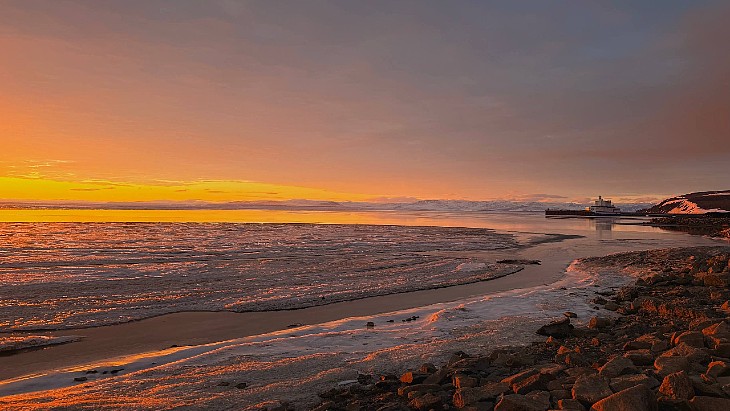
Floating nuclear power plant ‘has boosted air quality’
An environmental monitoring report for Russia’s floating nuclear power plant Akademik Lomonosov indicates that atmospheric pollutant emissions in the city of Pevek have fallen by almost 80% since the plant began supplying heat to the area in 2022. According to the operators, transferring a substantial share of the city’s heating demand to the nuclear plant reduced gross pollutant emissions from 11.64 to 2.281 tonnes, almost a fivefold decrease.
Environmental monitoring covers air emissions, water discharges, soil impacts and waste generation. Measurements reportedly remain within established limits, averaging less than 10% of maximum permissible values. Monitoring of Chaunskaya Bay in the East Siberian Sea has also detected no significant environmental changes, according to Russia’s state nuclear corporation Rosatom.
The Akademik Lomonosov began commercial operation in May 2020 and is currently the world’s only operating floating nuclear power plant. Located near Pevek on Russia’s Arctic coast, it supplies both heat and electricity to the city and supports mining development in the Baimskaya ore zone. It is equipped with two KLT-40S reactors, each generating 35 MWe, and can provide electricity for a city of up to 100,000 inhabitants.
Rosatom is building four additional floating power units and is also targeting export markets with larger floating plants equipped with RITM-200M reactors, designed for a service life of up to 60 years.
Kazakhstan aims for 100-year uranium reserve
Kazakhstan aims to establish a strategic uranium reserve sufficient to supply its planned nuclear power plants for more than 100 years. President Kassym-Jomart Tokayev has called for the development of a comprehensive state reserve to ensure long-term fuel security. The country’s strategy envisages reserving at least 150,000 tonnes of uranium by 2050.
State-owned uranium producer Kazatomprom has begun geological exploration in six areas covering more than 1,000 square kilometres, with additional investigations planned in the promising Kyzyltu area. The proposed reserve would cover the entire nuclear fuel supply chain, including uranium deposits, physical stocks of natural uranium and reserves of ready-to-use nuclear fuel.
The initiative is linked to Kazakhstan’s plans to develop nuclear power. The first nuclear power plant, the Balkhash project, is planned to comprise two Russian-designed VVER-1200 pressurised water reactors. An engineering, procurement and construction contract was signed with Rosatom in September 2026. Construction is targeted to begin in 2027, with the first unit expected to enter operation in 2034. The estimated cost of the two units is approximately USD 14.4 billion, with an additional USD 2 billion allocated for security systems and social infrastructure.
China National Nuclear Corporation is expected to build a second nuclear power plant, while preparations are also under way to identify a site for a third facility. Kazakhstan aims for nuclear power to account for 5% of national electricity generation by 2035.
The country holds approximately 14% of global uranium resources and has been the world’s leading uranium producer since 2009. In 2025, it produced around 25,839 tonnes of uranium, representing approximately 40% of global production.
IHI to supply components for first Polish AP1000
Japanese engineering company IHI Corporation has received an order from Westinghouse for engineering and procurement activities related to long-lead components for the first unit of Poland’s planned nuclear power plant at Lubiatowo-Kopalino. The contract covers one reactor containment vessel and the large CA01 steel-concrete structural module, both essential components of the AP1000 reactor design.
The CA01 module, consisting of 47 sub-modules, measures more than 26 metres in length, 29 metres in width and 23 metres in height. It is installed inside the containment structure and houses the reactor pressure vessel, steam generators and other major equipment.
The Polish project envisages three Westinghouse AP1000 reactors. Modular construction allows large structural and mechanical components to be manufactured in factories and subsequently assembled on site. Westinghouse has also placed conditional purchase orders with four Polish companies for additional structural modules, supporting the development of the domestic supply chain.
The current orders cover preliminary engineering, technical documentation, quality and supervision plans, supplier selection and the procurement of materials. Manufacturing and delivery of the finished components will be covered by subsequent contracts.
Early procurement of long-lead components is intended to secure manufacturing capacity and reduce the risk of construction delays. Construction at Lubiatowo-Kopalino is scheduled to begin in 2028. The first reactor is expected to enter commercial operation in 2036, with the entire plant scheduled to reach full capacity by 2038.