

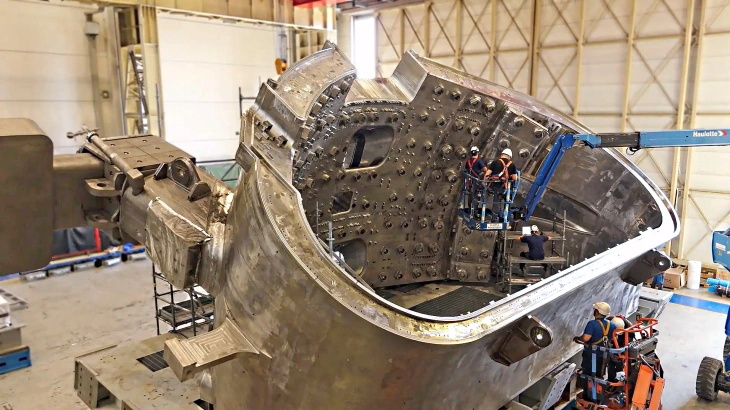
Europe delivers final ITER vacuum vessel sector
Fusion for Energy (F4E), working with Ansaldo Nucleare, Westinghouse and Walter Tosto, has completed and delivered Europe’s fifth and final vacuum vessel sector for the International Thermonuclear Experimental Reactor (ITER) in Cadarache, France. Manufactured at Westinghouse’s facility in Monfalcone, Italy, the component was transported by sea and land to the ITER construction site. Its arrival marks the completion of a manufacturing programme that began 16 years ago and the delivery of the final large ITER component to the site.
The vacuum vessel houses the fusion reactions and serves as the first safety containment barrier. It consists of nine steel sectors, each more than 14 metres high and weighing approximately 440 tonnes. Once assembled, the vessel will measure 19.4 metres in diameter and weigh about 5,200 tonnes, increasing to 8,500 tonnes after installation of internal components. Producing Europe’s five sectors required more than two million working hours and involved approximately 750 kilometres of welds.
ITER is an international project involving 35 nations, designed to demonstrate the scientific and technological feasibility of fusion as a large-scale, low-carbon energy source. The revised project plan targets deuterium-deuterium fusion operations in 2035. ITER will not generate electricity.
Green Party drops nuclear phase-out policy
Members of the Green Party of England and Wales have voted to remove the party’s policy calling for nuclear power to be phased out and to recognise nuclear fission as a low-carbon electricity source. The motion replaces the previous commitment to phase out nuclear power, coal and waste incineration with a broader policy targeting electricity generation incompatible with renewable energy and low-carbon objectives, including fossil fuels.
The revised policy continues to prioritise offshore wind, onshore wind and rooftop solar, while explicitly recognising nuclear fission alongside hydropower, tidal and wave energy, geothermal power and energy from waste as low-carbon sources. The motion also removes related policies elsewhere in the party’s programme, including a proposed immediate ban on shipments of nuclear fuel, plutonium and high-level radioactive waste.
Green Party Energy and Net Zero spokesperson Carla Denyer said the change does not commit the party to supporting new nuclear construction. Instead, it acknowledges that nuclear power can contribute during the transition towards electricity generation based primarily on renewables. Denyer also argued that keeping existing nuclear plants operating can be a low-carbon option because much of their carbon footprint arises during construction, while proposals for new plants should be assessed carefully for cost, construction time and environmental impact.
Hot Testing Begins At China’s Linglong-1 Small Modular Reactor
China’s Linglong-1 small modular reactor (SMR) demonstration plant has reportedly begun hot functional testing, according to unconfirmed local media reports. The reactor is being built at the Changjiang nuclear power site in Hainan province, southern China. Project workers are aiming to complete fuel loading and connect the plant to the electricity grid before the end of 2026.
Also known as ACP100, Linglong-1 is a 125 MW pressurised water reactor developed by China National Nuclear Corporation (CNNC). Construction began in July 2021, following earlier regulatory delays that postponed the project’s original start.
Hot functional testing is a major commissioning milestone before nuclear fuel is loaded. It verifies the performance of the reactor’s primary systems under operating temperatures and pressures without fuel present. The plant completed cold functional testing in October 2025, confirming that components of the primary circuit could withstand pressures exceeding those encountered during normal operation.
A CNNC official stated in December 2025 that commercial operation was expected in the first half of 2026, although the latest reports indicate that commissioning is still progressing. The ACP100 design received approval from the International Atomic Energy Agency in 2016. Linglong-1 could become the world’s first land-based commercial SMR to enter operation; Russia already operates SMRs aboard the floating nuclear power plant Akademik Lomonosov.
Swiss citizens may get to vote on construction of new reactors
Switzerland could hold a referendum on whether to lift its ban on constructing new nuclear power plants, following competing campaigns over the country’s future energy policy. The “No to New Nuclear Power Stations” coalition, comprising the Greens, Social Democrats, Green Liberals and other organisations, says it has collected more than 131,800 signatures, exceeding the 50,000 required for a referendum. The signatures have been submitted to the Federal Chancellery. If the referendum is approved, the vote could take place as early as 28 February 2027.
In response, the Alliance for Secure Electricity Supply has launched a campaign supporting the removal of the ban, which has been in force since 2018. The alliance includes business associations, nuclear industry organisations and electricity companies such as Axpo, Alpiq and BKW. Parliament has approved a counter-proposal to the “Stop the Blackout” initiative, which would allow new reactors to be considered under the revised Nuclear Energy Act.
Supporters argue that lifting the ban would preserve options for long-term electricity security without automatically committing Switzerland to building new plants. Opponents contend that new nuclear projects would be expensive, increase dependence on foreign energy and hinder renewable development.
Switzerland currently operates four reactors at three sites, generating about one-third of its electricity. The reactors have unlimited operating licences, subject to safety requirements.
Slovakia buys out Czech stake in new nuclear project company
Czech energy company ČEZ has sold its 49% stake in Jadrová energetická spoločnosť Slovenska (JESS) to Slovakia’s state-owned nuclear decommissioning company JAVYS for EUR 189 million (USD 211 million). The transaction gives the Slovak state full ownership of JESS, which was established in 2009 to prepare for new nuclear capacity near the existing Bohunice nuclear power plant.
Slovak Prime Minister Robert Fico said full state ownership would provide access to the company’s documentation and permits, helping accelerate preparations for a new nuclear power plant in the Jaslovské Bohunice area. ČEZ explained that the sale reflected the role of governments in directing new nuclear construction projects. The valuation was prepared by EY and confirmed by KPMG.
Earlier in 2026, Slovakia and the United States signed a memorandum of cooperation concerning a proposed 1,200 MWe nuclear unit to be owned by the US state. The project has been designated a strategic investment, according to Fico.
Slovakia currently has five operating nuclear reactors, with a sixth, Mochovce 4, undergoing commissioning. Once the unit reaches full power, nuclear energy is expected to account for 77.5% of the country’s electricity consumption. The government argues that additional nuclear capacity will be needed to support industrial development, including the automotive sector, artificial intelligence and data centres.