
Newcleo-led consortium to develop floating nuclear plant
A consortium led by France-based advanced reactor developer Newcleo has received nearly EUR1 million in French public funding to develop the conceptual design of a floating nuclear power plant capable of hosting multiple 200 MWe small modular reactors. The n-Floating project, supported through Bpifrance’s programme for decarbonising the French maritime sector, brings together Newcleo, Bureau Veritas Marine & Offshore and engineering company ABMI Groupe.
The concept envisages a non-self-propelled nuclear barge equipped with multiple LFR-AS-200 lead-cooled fast reactors. The reactors are designed to provide low-carbon electricity and process heat for industrial applications, including hydrogen production, data centres, cement and steel manufacturing.
Over an approximately 18-month programme, the consortium will assess the technical feasibility and potential applications of the floating plant, including supplying ports, coastal and isolated areas, desalination facilities and low-carbon fuel production. The project also aims to establish a development roadmap towards potential industrial deployment by 2036.
The initiative combines Newcleo’s reactor technology with maritime classification, regulatory and engineering expertise, with the stated ambition of developing a standardised solution designed and built in France.
Prodigy Signs Agreement For Transportable Nuclear Power Plant With Canadian Indigenous Communities
Canada’s Prodigy Clean Energy has signed an agreement with Pabineau First Nation and Eel River Bar First Nation to advance a First Nations-owned proposal for a transportable nuclear power plant in Belledune, New Brunswick. The proposed Prodigy Transportable Nuclear Power Plant (TNPP) would have a capacity of up to 50 MWe and is targeted to enter service in the early 2030s.
The pilot project is intended to demonstrate the logistics and operational requirements of transportable nuclear generation and establish a model for wider deployment across northern Canada and international markets. Prodigy plans to select the site and reactor technology, with a final investment decision targeted within 18 months and a reactor technology ready for deployment by 2032.
The New Brunswick government has signed a letter of intent to purchase electricity from the facility and is seeking federal recognition of the project as nationally transformative infrastructure. BWXT and Kinectrics will support licensing and supply-chain development.
The initiative is intended to provide a commercially demonstrated model for transportable nuclear power, particularly for remote and Arctic regions.
Rosatom considers Murmansk site focused on floating power plant construction
Russia’s state nuclear corporation Rosatom is considering establishing a new facility near Murmansk for the final stage of the floating nuclear power plants production, in response to an expected increase in orders. Rosatom Director General Alexei Likhachev said the investment could amount to “tens of billions of rubles”, with the company expecting demand for dozens of floating units.
Murmansk is being considered because of its proximity to Atomflot, which operates Russia’s nuclear-powered icebreaker fleet, as well as its port infrastructure and access to a large workforce. The proposed facility would complement existing cooperation with the Baltic Shipyard, whose capacity is increasingly occupied by orders for Project 22220 nuclear icebreakers and other Rosatom projects.
Russia already operates the world’s first commercial floating nuclear power plant, Akademik Lomonosov, which has two 35 MWe KLT-40S reactors and has supplied power and heat in Arctic Chukotka since 2020. Rosatom is also developing additional floating units and export-oriented plants of at least 100 MWe using RITM-200M reactors, derived from those used in modern icebreakers.
Helical selected for Japanese fusion demonstration project
Japan’s Helical Fusion has been conditionally selected by the Ministry of Economy, Trade and Industry (METI) as a project operator for a programme aimed at demonstrating fusion power generation in the 2030s. The initiative supports technologies under Japan’s national fusion strategy, with about JPY60 billion (USD370 million) in total subsidies expected to be allocated to selected operators by February 2029.
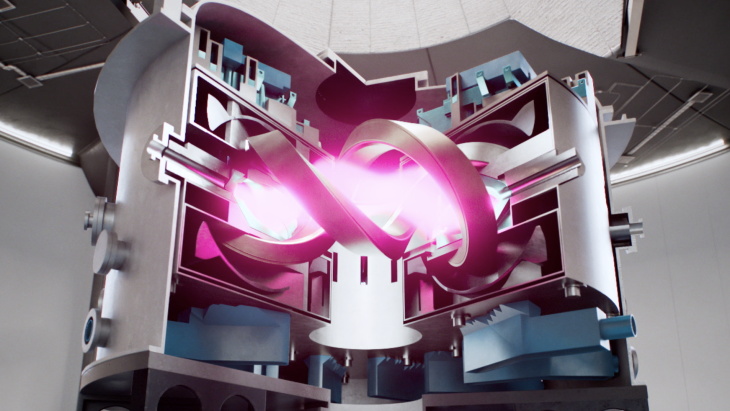
Founded in 2021, Helical is developing a fusion power concept based on the helical stellarator research conducted by Japan’s National Institute for Fusion Science. Its Helix Programme is focused on three requirements for commercially viable fusion: steady-state operation, net electricity production and efficient maintenance. The programme plans to demonstrate high-temperature superconducting magnets and blanket/divertor technologies before conducting an integrated demonstration with the Helix HARUKA device in the 2030s. The longer-term objective is the Helix KANATA power plant.
Unlike tokamaks such as ITER, stellarators use a twisted magnetic configuration designed to support continuous plasma confinement without the same operational constraints.