

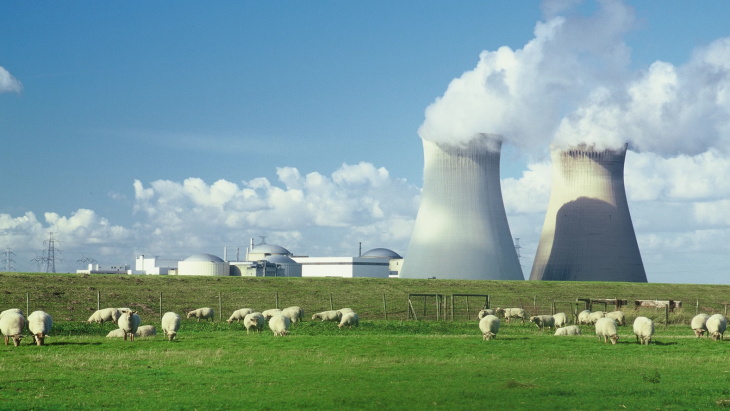
The Belgian government has started negotiations with Engie and its subsidiary Electrabel
to take direct ownership of Belgium’s seven nuclear reactors. The proposed agreement includes all nuclear assets, staff, subsidiaries, and liabilities, including decommissioning responsibilities. Belgium says the move supports its long-term energy security, climate goals, and plans to both extend existing reactors and develop new nuclear capacity. Decommissioning work has been suspended to preserve future options. Belgium had originally planned to phase out nuclear energy under a 2003 law, but energy security concerns following the Russia-Ukraine conflict led to policy changes. Two reactors, Doel 4 and Tihange 3, already received lifetime extensions to 2035, and the government now intends to extend them further. In 2025, parliament repealed the nuclear phase-out law, marking a major shift in Belgian energy policy toward renewed reliance on nuclear power.
EDF has announced a nearly €100 million investment through its subsidiary Arabelle Solutions
to build a new factory in Chalon-sur-Saône, eastern France, for manufacturing key equipment for EPR2 nuclear reactors. The facility will support France’s ambitious nuclear expansion programme, including six planned EPR2 reactors and eight possible additional units, as well as international projects. The factory will produce turbine hall components that improve heat exchange and electricity generation efficiency, such as superheater dryers and pressure heaters. Production is expected to begin in 2030, with the plant capable of supplying equipment for one nuclear reactor annually. The project will create around 160 jobs by 2030 and strengthen France’s domestic nuclear supply chain. The investment complements other EDF projects linked to new EPR2 reactors planned at Penly, Gravelines, and Bugey as France expands nuclear energy to support decarbonisation and energy security.
Ontario Power Generation (OPG) has reached a major milestone in the Darlington small modular reactor (SMR) project by installing the massive Basemat foundation module for the first SMR to be built in a G7 country. The 953-tonne, 37-metre-wide structure was lowered 35 metres underground using one of the world’s largest crawler cranes. This marks the first modularly assembled reactor foundation in Canada and supports the construction of the first of four GE Hitachi BWRX-300 reactors planned at the Darlington site. Ontario approved construction in 2025 following licensing by the Canadian Nuclear Safety Commission. The first reactor is expected to connect to the grid by 2030. The project is also boosting the Canadian economy, with more than 100 domestic companies involved in the supply chain and over CAD500 million invested in Ontario industries and jobs.
Leaders from major European fusion and industrial companies have urged the European Commission to create a long-term EU Fusion Strategy aimed at maintaining Europe’s leadership in commercial fusion energy. In an open letter addressed to Ursula von der Leyen and other EU officials, the companies warned that Europe risks falling behind countries such as the US, China, Japan, and Canada, which are rapidly increasing investment in fusion technology. The signatories stressed that fusion energy should become a strategic priority for energy security, competitiveness, and climate goals. They called for milestone-based funding, technology-neutral policies, dedicated regulation distinguishing fusion from fission, and stronger European supply chains and workforce development. The industry believes commercial fusion plants could be built in the 2030s if the EU acts quickly. The proposed strategy would support innovation, industrial growth, energy independence, and high-skilled employment across Europe.
Unit 1 of the San’ao Nuclear Power Plant has officially entered commercial operation, according to China General Nuclear (CGN). The 1,116 MWe Hualong One (HPR1000) reactor is the first of six planned units at the site and the first in China’s Yangtze River Delta region using this domestically developed reactor design. Construction began at the end of 2020, and the reactor achieved commercial operation just over five years later after completing all commissioning and safety tests. The full San’ao project is expected to generate more than 54 TWh of electricity annually while significantly reducing coal consumption and carbon dioxide emissions. The plant also marks China’s first nuclear project involving private capital, with Geely Technology Group
holding a minority stake. With this addition, CGN now operates 30 nuclear power units with a combined installed capacity exceeding 34 GW.
Rosatom has completed pilot operation tests of special MOX nuclear fuel containing minor actinides in the Beloyarsk Nuclear Power Plant BN-800 fast reactor. The fuel assemblies, loaded in 2024, included americium-241 and neptunium-237—long-lived radioactive elements that significantly contribute to nuclear waste toxicity and heat generation. After three fuel campaigns, the assemblies will now undergo cooling and post-irradiation examination. The project aims to demonstrate that fast reactors can “burn” minor actinides by transforming them into shorter-lived or more stable isotopes, potentially reducing the amount and long-term hazard of radioactive waste requiring geological disposal. According to Rosatom’s fuel division TVEL, the experiment is part of a broader research programme running until 2035. Future plans include increasing the concentration of minor actinides in fuel and testing new fuel configurations. The BN-800 reactor already operates fully on MOX fuel recycled from used nuclear fuel.
Clean Core Thorium Energy announced that its patented thorium-based ANEEL nuclear fuel successfully completed irradiation testing at the Idaho National Laboratory Advanced Test Reactor. The fuel exceeded a burnup level of 60 GWd/MTU, more than eight times higher than the typical performance of traditional Candu and pressurised heavy water reactor fuels. ANEEL fuel combines thorium with high-assay low-enriched uranium (HALEU) and is designed for use in existing heavy water reactors without major modifications. According to the company, the fuel offers improved efficiency, enhanced safety, reduced nuclear waste, and greater proliferation resistance. Initial post-irradiation examinations indicate strong structural integrity and superior fission gas retention compared with conventional uranium fuel. The project marks an important step toward commercial deployment of thorium fuel technology. The company is now preparing demonstration fuel bundles and future testing in commercial reactors to support broader adoption.