

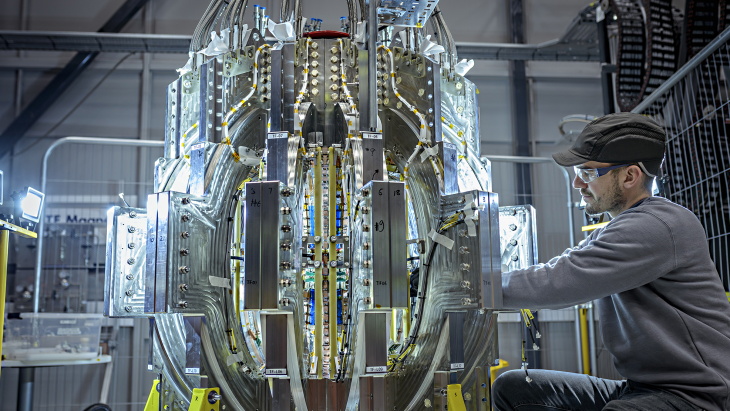
The UK has awarded GBP100 million in contracts to support development of its prototype fusion power plant, the STEP fusion programme. Tokamak Energy secured a GBP70 million contract to deliver advanced high-temperature superconducting (HTS) magnet systems, a critical component for fusion reactors. The company will act as a systems partner, contributing to magnet design, tokamak integration, and plasma systems, while leveraging its ST40 experimental reactor.
In parallel, Dassault Systèmes received a GBP30 million contract to enhance the plant’s digital infrastructure using its 3DEXPERIENCE platform. This system will centralise design, simulation, and operational data, enabling more efficient engineering, risk reduction, and the creation of digital twins for testing and optimisation.
The STEP project, planned for the West Burton site and expected to operate by 2040, aims to demonstrate commercially viable fusion energy. These contracts mark a significant step in building the technical and industrial capabilities needed for future fusion power.
According to the International Energy Agency, global nuclear power construction is at one of its highest levels in three decades, with 78 GW of capacity under development across 15 countries. China dominates this expansion, accounting for about نصف of the total and aiming for 100 GW of installed capacity by 2030. Other developing countries such as Egypt, India, and Turkey each have around 5 GW under construction. Advanced economies including Japan, South Korea, the UK, and Slovakia contribute a combined 9.5 GW. Most reactors being built are large-scale, though small modular reactors (SMRs) are emerging, particularly in China and Russia. In 2025, 3 GW of new nuclear capacity was added but offset by equal retirements, keeping global capacity at 420 GW. Renewable and nuclear energy growth together outpaced overall electricity demand increases, with low-emission sources contributing nearly 60% of global demand growth.
Bulgaria has officially opened its national repository for low- and intermediate-level radioactive waste near the Kozloduy Nuclear Power Plant. The facility will operate for about 60 years before being closed and monitored for over 300 years. It consists of 66 reinforced concrete structures with a total capacity of 138,200 cubic metres of waste. The repository will store only domestically generated low- and intermediate-level waste from industry, medicine, household sources, and the decommissioning of older Kozloduy units, excluding high-level waste and spent fuel. Built to International Atomic Energy Agency safety standards, the near-surface facility uses multi-barrier protection. Construction began in 2017 after extensive studies, fulfilling commitments made during Bulgaria’s European Union accession. The project was supported financially through international funding. The repository marks a major step in establishing a comprehensive national system for radioactive waste management.
The European Commission has urged member states not to prematurely close nuclear power plants as part of its response to an energy crisis triggered by conflict in the Middle East and disruptions such as the Strait of Hormuz closure. With 57% of EU energy still coming from fossil fuels and €340 billion spent on imports in 2025, the Commission stressed the need to accelerate clean, domestic energy production. It highlighted nuclear power as a key component for decarbonisation, energy security, and industrial competitiveness, recommending both the deployment of small modular reactors (SMRs) and the extension of existing plants’ lifetimes. According to its Nuclear Illustrative Programme, €241 billion in nuclear investment is needed by 2050. The debate remains divided across Europe, with countries like Germany and Spain moving away from nuclear, while France and Belgium are expanding or extending their nuclear capacity.
A memorandum of understanding has been signed to advance the development of molten salt reactors (MSRs) in the Netherlands, led by Thorizon and partners including NRG-Pallas and EPZ. The plan outlines three milestones: a non-nuclear test facility in Zeeland by 2027, a nuclear demonstrator (Thorizon Pioneer) in Petten by 2028, and the first commercial MSR, Thorizon One (100 MWe), in Zeeland by 2034. The Pioneer reactor will validate core technologies, while Thorizon One aims to supply low-carbon energy and recycle long-lived nuclear waste using thorium-based fuel. The project is expected to attract over €1 billion in investment and create thousands of jobs, positioning the Netherlands as a hub for advanced nuclear innovation. Regional authorities and investors are supporting licensing, funding, and deployment, with potential backing from the European Investment Bank.
Unit 6 of the Kashiwazaki-Kariwa Nuclear Power Plant has resumed commercial operation, marking the first restart by Tokyo Electric Power Company since the Fukushima Daiichi nuclear disaster. The 1,356 MWe Advanced Boiling Water Reactor had been offline since 2012 and underwent multiple restart attempts in early 2026, facing technical issues such as control rod alarms and equipment damage. After repairs and inspections, the reactor successfully completed performance testing under the supervision of the Nuclear Regulation Authority, which granted approval for commercial operation. Although the Kashiwazaki-Kariwa plant was not directly affected by the 2011 disaster, all its units were shut down afterward. Restarting Unit 6 is part of Japan’s gradual return to nuclear power, with 14 reactors now back online. The move is expected to improve TEPCO’s financial performance and strengthen energy supply stability.