

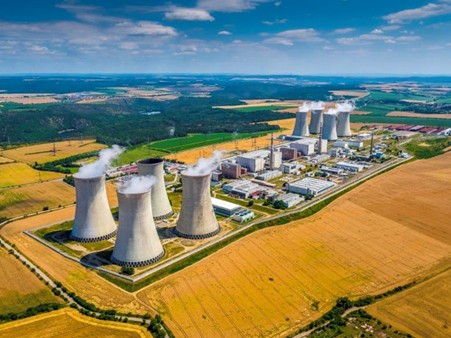
The Czech utility ČEZ has begun preparations to extend the lifetime of the Dukovany Nuclear Power Plant to up to 80 years, potentially allowing operation until 2065–2067.
This reflects a global trend toward longer reactor lifetimes, provided that safety and technical conditions are regularly assessed.
ČEZ is also studying a similar extension for the Temelín Nuclear Power Plant. Both plants have already undergone upgrades that increased their output, and together they supplied over 40% of the Czech Republic’s electricity in 2024.
Long-term operation will require significant investment in modernisation, including upgrades to key systems and safety components. Annual spending on safety improvements is already substantial.
The Czech Republic also plans to expand nuclear capacity with new reactors at Dukovany and potentially Temelín, as part of its strategy to phase out coal by 2033 and transition to a low-carbon energy mix.
South Korea’s Nuclear Safety and Security Commission has cleared the Saeul Unit 3 reactor for start-up after completing all required pre-operational inspections before initial criticality.
The regulator confirmed that the unit can safely achieve a sustained nuclear chain reaction, marking a key milestone toward commercial operation.
Construction of Saeul units 3 and 4, based on APR1400 technology, began in 2017 after delays and a temporary suspension linked to a government policy review. Despite earlier plans for operation in 2021–2022, the project timeline was extended. An operating licence for unit 3 was issued in December 2025, followed by fuel loading and testing.
Commercial operation of Saeul 3 is expected around August 2026, with unit 4 to follow later the same year. Once operational, the reactor will contribute about 1.7% of South Korea’s electricity and a significant share of regional demand. The project reflects the country’s continued reliance on advanced nuclear technology.
Lithuania’s nuclear regulator has approved dismantling and decontamination work at Unit 2 of the Ignalina Nuclear Power Plant, following the completion of reactor channel dismantling at Unit 1. The project includes removing piping systems, fuel channels, and control and safety components, along with initial radioactive waste treatment.
The work will be led by Altra, with dismantling scheduled to begin in late 2026 after preparatory activities such as installing engineering systems and upgrading waste management infrastructure. The company emphasised that this marks a major step in one of the world’s most complex nuclear decommissioning projects.
Since dismantling began in 2010, overall progress has reached nearly 46%. The most challenging phase—removal of highly radioactive reactor cores—still lies ahead and will involve external contractors and robotic technologies.
Final dismantling is planned by 2043, with full decommissioning completed by 2050. The project is largely funded by the European Union.
The United Kingdom Atomic Energy Authority has launched a new fusion strategy for 2026–2030 aimed at advancing the UK’s position in nuclear fusion.
A key goal is completing the detailed design of the STEP fusion prototype power plant, planned to be operational by 2040, while also expanding the number of UK companies involved in the global fusion supply chain.
The strategy aligns with the UK government’s ambition to establish a clear path toward commercial fusion energy and attract private investment. It includes developing new research facilities at Culham, training a skilled workforce, and supporting innovation in fusion technologies.
Fusion is seen as a promising source of large-scale, low-carbon energy, but significant technical challenges remain, including plasma control, energy efficiency, fuel self-sufficiency, and system integration.
To support progress, UKAEA has launched new initiatives such as the Diagnostics Innovation Centre of Excellence and robotics training programmes, while also encouraging SMEs to participate in the rapidly growing global fusion market.
Belgium is leveraging renewed interest in nuclear energy to strengthen its leadership in nuclear medicine, particularly radioligand therapy. According to Stien Schrauwen, this field is a strategic priority due to its scientific value and importance for national sovereignty. In 2025, Belgium helped treat nearly 13 million patients worldwide through the production of medical radioisotopes.
Institutions such as SCK CEN aim to position Belgium as a global pioneer in radioligand therapy, a targeted cancer treatment that delivers radiation directly to tumour cells while sparing healthy tissue. The number of eligible patients is expected to grow significantly by 2035, with hundreds of clinical trials underway globally.
However, challenges remain, including infrastructure, regulation, and slow market adoption in Europe. Belgium has also reversed its nuclear phase-out policy and plans to expand nuclear capacity, reinforcing its role in both energy and medical nuclear sectors.