

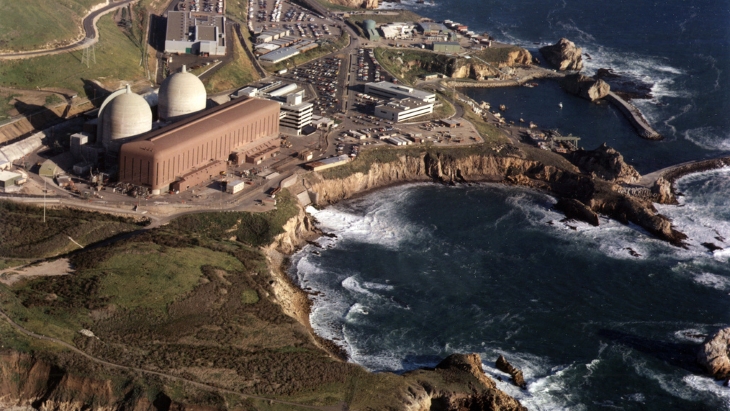
Diablo Canyon receives licence renewals
Pacific Gas & Electric Co’s two pressurised water reactors in Avila Beach, California are the 99th and 100th reactors to receive 20-year licence renewals from the US Nuclear Regulatory Commission, clearing them to operate until the mid-2040s.
Diablo Canyon provides nearly 9% of California’s electricity and 17% of its zero-carbon energy. Ten years ago, Pacific Gas & Electric (PG&E) reached an agreement with environmental and labour groups to retire unit 1 in November 2024 and unit 2 in August 2025. In September 2022 – as California’s energy grid saw its highest-ever peak demand during a record-breaking heatwave – the state passed a law allowing the two units to continue operation until 2030.
US nuclear power plants are initially licensed by the US Nuclear Regulatory Commission (NRC) to operate for up to 40 years. Operators can request a 20-year initial licence renewal, which covers an operating life of up to 60 years. Second – or subsequent – licence renewals can allow operation up to 80 years.
The Diablo Canyon units’ licences were due to expire in 2024 and 2025, respectively. Applications for licence renewals have to be submitted at least five years before a licence is due to expire: PG&E had submitted licence renewal applications for the Diablo Canyon units in 2009, but withdrew those applications in 2018 with the expectation that the plants would close before the licences expired. The company requested for the NRC to resume the relicensing in 2022.
WHO Head Sounds Alarm Over Safety At Iran’s Nuclear Facilities
The head of the World Health Organisation (WHO) on Sunday sounded the alarm over the safety of Iran’s nuclear facilities in the face of US and Israeli strikes.
“I join the International Atomic Energy Agency [IAEA] in raising the alarm again over the safety of nuclear facilities in Iran. The latest incident involving the Bushehr nuclear power plant is a stark reminder: a strike could trigger a nuclear accident, with health impacts that would devastate generations,” WHO director-general Tedros Adhanom Ghebreyesus wrote on US social media platform X.
He warned that threats are rising higher as the Middle East conflict continues and called for an immediate de-escalation.
Tedros’ remarks came after attacks on 4 April struck Iran’s Bushehr nuclear plant and several petrochemical hubs, including the Mahshahr and Bandar Imam special petrochemical zones.
The IAEA said on 4 April it had been informed by Iran that a projectile struck close to the premises of the Bushehr nuclear power station, the fourth such incident in recent weeks.
Iran also informed the IAEA that one of the site’s physical protection staff members was killed by a projectile fragment and that a building on site was affected by shockwaves and fragments. No increase in radiation levels was reported.
In a statement on X, IAEA director-general Rafael Grossi expressed “deep concern” about the reported incident and said nuclear power station sites or nearby areas must never be attacked, noting that auxiliary site buildings may contain vital safety equipment.
Reiterating call for maximum military restraint to avoid risk of a nuclear accident, Grossi again stressed the “paramount importance” of ensuring nuclear safety and security during a conflict.
Chernobyl Donors Back Plans For Possible €500 Million Repair Work On New Safe Confinement
Donors to the International Chernobyl Cooperation Account (ICCA), managed by the European Bank for Reconstruction and Development (EBRD), have endorsed plans for early engineering and procurement works that will pave the way for potential repairs to the New Safe Confinement (NSC) at the Chernobyl nuclear power station in Ukraine.
A Russian drone strike in February 2025 damaged the NSC, the giant structure built to contain the remains of Unit 4 and enable the safe dismantling of the original sarcophagus, which was hastily built after the 1986 accident.
Preliminary assessments by Novarka 2 – comprising the original NSC designer-builder Bouygues Travaux Publics and Vinci Construction Grands Projets – estimated that the corrosion of the steel arch threatened the long-term safety of the NSC, and that work was needed to restore the structure to full functionality by 2030. Repairs could cost at least €500m ($576m).
The endorsed plan is designed to create a solid basis for a later decision on how the construction should proceed. Donors have approved the EBRD’s recommendation to allocate €30m for this purpose.
The programme will be delivered in three phases, enabling a measured approach that will reduce the risk of redesign, delay and premature commitments.
Phase 1 will consolidate existing technical data, carry out targeted investigations and develop initial repair concepts.
Phase 2 will transform these concepts into engineering solutions and develop the overall repair strategy, in consultation with Ukraine’s nuclear regulator.
Phase 3 will prepare the plan for potential implementation through detailed engineering, procurement documentation and, where justified, early procurement of long-lead items.
Donors to the ICCA currently include the European Union, France, Norway, the UK, Canada, Germany, the Taiwan Business-EBRD Technical Cooperation Fund, Belgium and Italy.
Read more
Commission calls for Norway to prepare for nuclear energy
The Norwegian Nuclear Commission has recommended that the government does not start a process for nuclear power development in the country at this stage, but says it should prepare for its possible future use.
“The need for emission-free and stable energy sources that can help manage the natural and climate crisis and meet an increasing need for power has contributed to raising the question of nuclear power in Norway, as have the technological development and plans to establish nuclear power production from private players in cooperation with municipalities,” the government said.
The Norwegian government appointed the commission in June 2024 to conduct a broad review and assessment of various aspects of a possible future establishment of nuclear power in the country. The commission – chaired by Kristin Halvorsen, former director of the Centre for International Climate and Environmental Research – Oslo (Cicero) – was tasked with examining several key issues, including whether nuclear power is suitable for the Norwegian power system, the status of research and technology development, costs and other significant consequences for governments and private actors, land and environmental impacts, waste issues, nuclear safety, security and non-proliferation, preparedness and competence needs. Nuclear power in Norway was last examined by a public committee in 1978.
Study highlights opportunities for Dutch nuclear supply chain
With the Dutch province of Zeeland under consideration as the location of two new nuclear power plants, a new report says local businesses could capture up to EUR4.6 billion (USD5.4 billion) in direct economic value during the 12-year construction period.
The study – conducted by Tractebel and Technopolis and commissioned by the Province of Zeeland, Impuls Zeeland and VNO NCW Brabant Zeeland – outlines how companies in Zeeland, one of the preferred locations for new nuclear reactors, can position themselves within the nuclear supply chain and benefit from future investments.
Conducted between July 2025 and January 2026, the analysis explored prospects primarily for large nuclear new build projects, as well as for small modular reactors (SMRs) and the lifetime extension of the existing Borssele nuclear power plant.
The study identified 130 Zeeland businesses that could potentially supply nuclear projects, mostly as component suppliers and subcontractors. “Opportunities are strongest in construction, infrastructure, and transport & logistics, and during early construction phases and site clearance/landscaping,” it says. “As a first estimate, local involvement could account for roughly 15% of total plant costs.”