

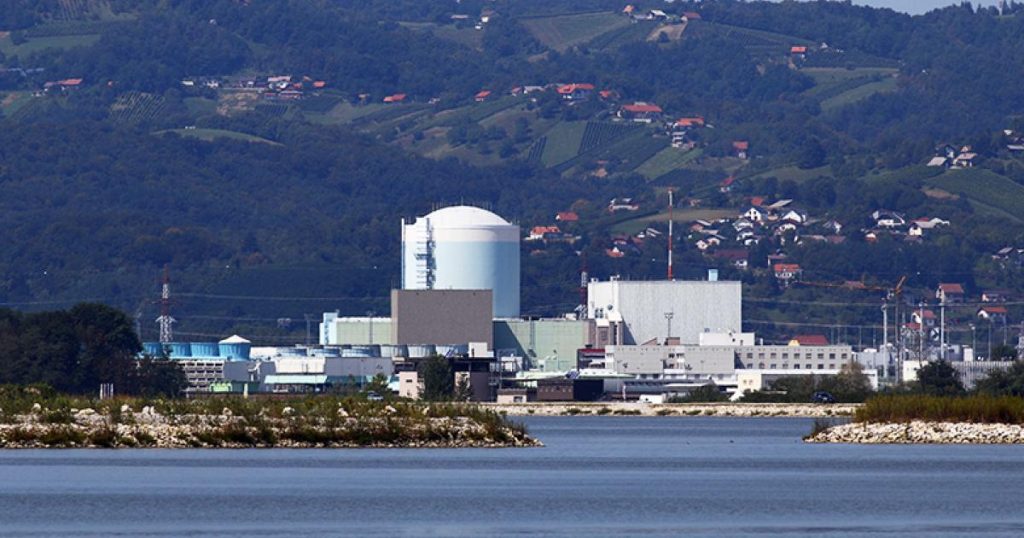
The Slovenian government said it will proceed with a national spatial plan (NSP) for the plant, which would provide all the details regarding the location of the new reactor, financing, technology and suppliers.
Speaking to media after the announcement of the NSP, Slovenia’s prime minister Robert Golob said that a second report from the country’s Ministry of Finance highlighted the importance of financing for any potential new reactor.
He said that half the price of a new nuclear facility depends on financing costs and that such a project was capital-intensive with long repayment periods.
“The prices we were informed about today are very favourable for the development of energy-intensive industry in Slovenia and for the economic development of the country. We are happy to continue the procedures to reach the point in the next two years when citizens will be able to decide whether we want to build a second unit or not,” said Golob.
He said a referendum would take place by the end of 2027 or the beginning of 2028.
Golob added that state debt was by far the most favourable financing option for nuclear as it “gives prospects that the price from the new facility will not only be competitive for Slovenian industry, but competitive internationally.”
The Krško power plant is owned equally by Croatian utility Hrvatska Elektroprivreda and Slovenia’s state-owned power generator, GEN Group, the parent company of power company Gen Energija. However, current plans for a new Krško reactor are being pursued solely by Slovenia.
Krško supplies around 20% of Slovenia’s electricity needs and 16% of Croatia’s.
In October, 2025, Slovenia signed an agreement with France’s state power company EDF on nuclear cooperation. The French firm will vie with US-based Westinghouse to build a potential second unit.
The 696-MW Krško plant already uses Westinghouse reactor technology and is Slovenia’s only nuclear station. It is in the east of the country on the border with Croatia and began commercial operation in 1983.
Croatia Sets Goal Of 30% Electricity From Nuclear By 2040 Under New Draft Law
Croatia has set a target of producing 30% of its electricity demand from nuclear sources by 2040 under a new draft law covering the development of nuclear energy in the country.
The draft law also stated that within six months an “activity programme” would be developed covering all necessary studies and analyses, and a year later a Plan for the Development of Nuclear Energy for Civilian Purposes would be presented.
A separate law would then be enacted deciding the final location of any potential nuclear power plant once all regulatory procedures had been carried out.
The draft law was presented by Croatian economy minster Ante Šušnjar, who said it represented a strategic step forward in strengthening the country’s energy security, the competitiveness of its economy, and sustainability of its electricity system.
“At a time when electricity consumption is growing and climate goals are becoming ever more demanding, nuclear energy represents a stable, low-carbon, and long-term cost-effective source of energy,” said Šušnjar.
“With this law, Croatia chooses a new energy source and makes a strategic decision that confirms its commitment to energy security, climate responsibility, and technological progress.”
Croatia does not have any nuclear power plants on its own territory, but it co-owns the single-unit Krško nuclear power plant in neighbouring Slovenia.
The draft law said the government would continue to consider additional units at Krško and look at further nuclear capacities including small modular reactors (SMRs).
France Publishes Energy Roadmap That Confirms Plans For Six New Nuclear Power Plants
France has published a key energy roadmap, aiming for 60% electricity consumption by 2030, with six new nuclear reactors and a mix of renewable energies.
At the heart of the strategy, officially labelled the third multi-year energy programme, or PPE3, is the major objective of increasing electricity’s share of France’s total energy consumption to 60% by 2030, up from around 30% today.
Reports in France said the PPE3 had been finalised after years of wrangling. It calls for cuts in wind and solar power targets and drops a mandate for state-run firm EDF to shutter nuclear plants.
Six new-generation EPR2 nuclear reactors are included in the roadmap, with eight additional reactors listed as an option.
State-owned power company EDF said it was committed to the PPE3 with the construction programme for six EPR2 nuclear reactors and an option for eight more, extending the operating life of existing nuclear reactors, and revitalising investments in hydropower while maintaining expertise in renewable energy, particularly offshore wind projects.
“EDF teams are mobilised to carry out these projects in compliance with the requirements set in terms of safety, security, quality, deadlines and costs,” a statement said.
EDF chairman and chief executive officer Bernard Fontana said: “The publication of the multi-year energy programme allows EDF to move forward towards its objectives: to provide the French people, today and for future generations, with competitive, sovereign and low-carbon electricity.”
France’s state-owned multinational fuel cycle company Orano said the opportunities presented by the PPE3 represent significant ongoing and future investments across the entire fuel cycle. This includes the challenge of ensuring mining supplies and increasing industrial uranium enrichment capacity.
The PPE3 would also mean the continuation of France’s treatment and recycling strategy, including the “renewal” of the La Hague nuclear fuel treatment and recycling plant in Normandy, northern France, and the Melox recycling plant in Gard, southern France, Orano said.
It said this translates into a programme representing significant investments over several decades.
EDF has already submitted an application for authorisation to build two EPR2 plants at Penly in Normandy. A second pair of EPR plants is being planned for Gravelines, about 170 km northeast of Penly.
EDF said in October that it was planning to submit an application for an environmental permit and begin preparatory work as early as 2027 for a two EPR2s at the Bugey site, in southeastern France.
Bugey would be the third project in a major French plan to deploy new EPR2 units.
Read more