

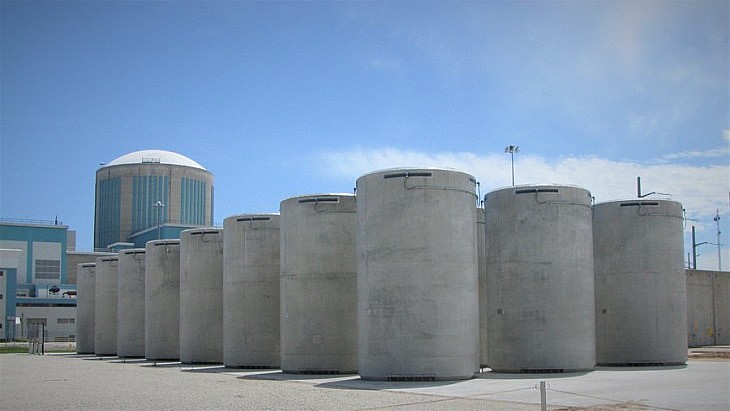
US funding for research into recycling used nuclear fuel
The US Department of Energy’s Office of Nuclear Energy has awarded more than USD19 million to five US companies to research and develop recycling technologies for used nuclear fuel.
The Department of Energy (DOE) noted that less than 5% of the potential energy in the USA’s nuclear fuel is extracted after five years of operation in a commercial reactor. It says recycling used nuclear fuel could increase resource utilisation by 95%, reduce waste by 90%, and decrease the amount of uranium needed to operate nuclear reactors. Additional benefits to nuclear fuel recycling include the recovery and extraction of valuable radioisotopes for medical, industrial, and defence purposes.
The DOE has selected five companies to help solve the economic and technological challenges associated with nuclear fuel recycling technologies that also meet the USA’s strict non-proliferation standards and national security goals.
Europe Cannot Afford To Prematurely Shut Down Nuclear Plants, Says Scientific Council Report
The European Nuclear Society’s (ENS) High Scientific Council (HSC) has called on European leaders to integrate long-term operation (LTO) of existing nuclear power plants into national and EU-level energy strategies, warning that Europe cannot afford to prematurely shut down safe, low-carbon reactors.
In a position paper, the HSC said LTO of existing nuclear power plants is a “strategic asset” in the fight against climate change, helping to “bridge the gap” to the commissioning of new nuclear builds while ensuring energy security and affordability.
The HSC is a scientific body of independent experts that advises the Brussels-based ENS on nuclear developments and acts as a think-tank for science and technology.
The position paper argued that extending the operating life of Europe’s current nuclear fleet is essential to meeting EU climate and energy objectives, including the goal of more than 90% decarbonised electricity by 2040, while avoiding higher system costs and increased reliance on fossil fuels.
LTO is the operation of a nuclear plant beyond the timeframe originally assumed in its design, usually 30 or 40 years.
The HSC said this is not an “exceptional process” because many reactors in the US and Europe are already operating for 60 years or more.
The paper said that the cost to retrofit a plant for LTO is about 10 times lower per gigawatt than building a new one. LTO projects have much shorter “construction” periods of roughly two years, compared to the nine years expected for new Generation III+ reactors, it said.
These plants also provide essential “ancillary services” like grid inertia and frequency control, which help stabilise the power system as more weather-dependent renewables are added.
The paper warned that without LTO programmes, Europe’s nuclear capacity would fall sharply by 2050, even if new build projects proceed as planned. This would increase pressure on electricity systems, raise costs for consumers and industry, and risk higher emissions through greater use of fossil fuels.
The HSC said its findings align with the European Commission’s 2025 nuclear illustrative programme (Pinc). The Pinc document estimates that Europe requires €241bn in nuclear investment by 2050 to meet net-zero targets. The Pinc report warned that without LTO, the EU’s nuclear capacity would be close to nothing by 2050, making the energy transition significantly more difficult.
‘Not In Competition With New Build’
The HSC paper said LTO is not in competition with new nuclear build, but complements it by providing an energy system bridge while new reactors, including small modular reactors, are developed and deployed.
The paper acknowledged that LTO requires careful management of technical, regulatory and economic challenges. These include ageing management of critical components, maintaining robust safety, ensuring regulatory compliance, modernisation and digitalisation of operation, securing supply chains for replacement parts, and preserving skilled workforces and institutional knowledge.
The HSC called for LTO of existing nuclear power plants to be fully integrated into national and EU energy strategies and European financing rules such as the taxonomy to ensure LTO is recognised as an eligible activity for investment.
Failing to pursue LTO, the HSC warned, would increase energy security risks, undermine climate goals, weaken Europe’s geopolitical standing, diminish nuclear expertise and future industrial potential, and raise overall energy system costs.
Nuclear generation set a new record in 2025 and is set to continue rising steadily through 2030, according to the International Energy Agency.
Nuclear power output in 2025 was up 1.2%, supported by reactor restarts in Japan, higher generation in France, and new capacity additions in China, India and other countries, the agency said in its electricity 2026 analysis and forecast to 2030.
While most of the growth in nuclear generation until 2030 is expected to occur in emerging economies, with China alone accounting for around 40% of the global increase, nuclear energy is also regaining strategic importance in many advanced economies, underpinned by supportive policy frameworks to extend the lifetime of reactors and add new capacity.
Global electricity generation will reach multiple new milestones in the period 2026-2030. This is particularly the case for low-emissions generation sources – renewables and nuclear – which will continue expanding and setting new records. The report said renewables and nuclear are together expected to account for around half of global electricity generation by 2030.
Renewable energy is now outpacing coal, with nuclear generation simultaneously reaching historic highs. Constrained by growth in low-emissions sources, coal-fired generation globally is forecast to record slight declines, where demand growth through 2030 will be met by renewables, natural gas and nuclear.
Nuclear generation is set to increase by an average of 2.8% over the forecast period, more than double the 1.3% growth rate in 2021 2025. The gains are led by new reactors being commissioned in China, India, South Korea and other countries, restarts in Japan, and robust output in France from the planned advancement of the maintenance works.
Nuclear electricity output is expected to remain relatively stable in both the US and the European Union over the forecast period, while it increases strongly in China, where almost 30 GW of new nuclear capacity is expected to come online over the five-year 2026-2030 outlook.
Nuclear generation in China is expected to increase by nearly 6% per year on average to 2030. Consequently, China’s share of global nuclear generation is projected to rise from 17% in 2025 to 20% in 2030, whereas the US share will decline from 29% to 25% and the European Union’s from 23% to 20%.
Small Modular Reactors ‘A Major Focus’
Despite these falling shares, increasing nuclear generation is a major focus in the US, with new small modular reactor (SMRs) capacity slated to come online just outside the report’s 2026-2030 forecast period. There is also strong interest in many countries of the European Union, with policies in place for lifetime extensions and expansion of nuclear capacities.
Globally, SMRs are receiving particularly high levels of attention, both from the public sector and also from private industry, such as from large technology companies, as the modular designs and smaller scale of SMRs make them more attractive for financing and deployment by the private sector.
Nevertheless, the IEA warned that the success of the technology depends on a combination of government commitment and supportive policies, timely regulatory design reviews, continued innovation from technology developers, and financing from both public and private sectors.
Poll Shows Over 90% Support For Nuclear Power In Poland
More than 90% of Poles support building nuclear power plants in the country, according to a new nationwide survey commissioned by the energy ministry.
The study, carried out in late 2025, found that 91.9% of respondents back nuclear energy, while nearly 80% would accept a nuclear power plant being built near their homes.
Opposition stood at just over 5%, the survey found.
Acceptance of local plant siting has remained close to 80% since 2024, while opposition has fallen steadily by about two percentage points a year since 2023.
Energy minister Miłosz Motyka said the results show stable and strong public backing for Poland’s nuclear programme and confirm nuclear power’s role in energy security and price stability.
The survey also found that 94% of respondents believe nuclear power will improve Poland’s energy security, while 88% see it as an effective low-carbon tool to address climate change.
Support was higher among men than women and strongest among younger respondents aged 15-29, while lower levels of backing were recorded in the 50-75 age group. High support was reported across all regions of the country.
A majority (72%) of respondents said the internet was their main source of information on the matter.
In 2022, Warsaw chose Westinghouse to supply its AP1000 pressurised water reactor technology for the construction of three units near the villages of Lubiatowo and Kopalino in the northern province of Pomerania, northwest of the city of Gdansk.
The first reactor unit is expected online in 2036, according to the latest public schedule.