

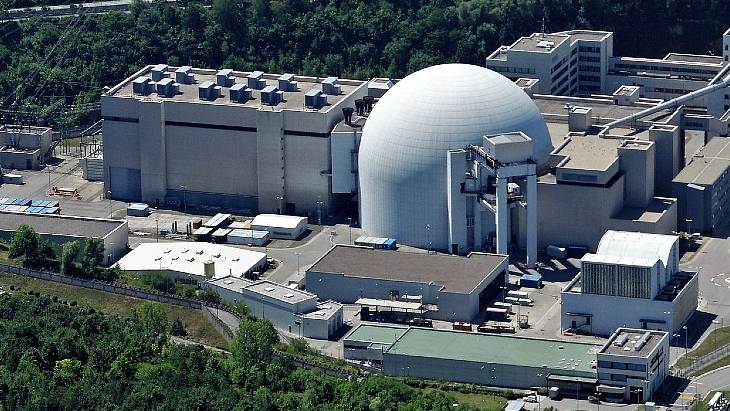
Germany’s shut down of nuclear plants a ‘huge mistake’, says Merz
Germany’s decision to shut down all its nuclear power plants was a “huge mistake” and has come at a high cost to the economy, Chancellor Friedrich Merz said yesterday, speaking to the German Chamber of Industry and Commerce in Dessau.
His comments reignited debate over the country’s long-term energy strategy and power generation capacity.
“It was a serious strategic mistake to phase out nuclear energy … we simply don’t have enough energy generation capacity,” Merz said.
Germany’s energy system now relies on state intervention to keep prices at acceptable levels.
“To have acceptable market prices for energy production again, we would have to permanently subsidise energy prices from the federal budget,” Merz said, adding: “We can’t do this in the long run.”
Germany’s nuclear phase-out was accelerated following the Fukushima nuclear disaster in Japan in March 2011. The government led by then-chancellor Angela Merkel moved to speed up an exit plan that had first been adopted in 2000. The policy aimed to reduce nuclear risks while advancing the Energiewende, or “energy turnaround”, Germany’s energy transition centred on renewables.
Merz said the decision to exit nuclear power had long-term strategic consequences.
Over the 2010s, Germany progressively shut down its nuclear fleet. The phase-out concluded in April 2023, when the final three reactors — Isar 2, Emsland and Neckarwestheim 2 — were permanently taken offline, ending about six decades of nuclear electricity generation.
The closures came amid Europe’s energy crisis following Russia’s invasion of Ukraine. Despite renewed debate about nuclear power’s role in energy security, the remaining reactors’ operating lives were extended by only three months before being shut down.
Merz said Germany should at least have retained its last remaining nuclear capacity during that period.
“If you are going to do it, you should at least have left the last remaining nuclear power plant in Germany on the grid three years ago, so that you at least have the electricity generation capacity that we had up until then,” he said.
He added that the nuclear exit had contributed to high costs and complexity in Germany’s energy transition.
“So we are now undertaking the most expensive energy transition in the entire world,” he said. “I know of no other country that makes things so expensive and difficult as Germany.”
The nuclear phase-out, endorsed by successive governments, has been criticised by opponents as complicating Germany’s goal of achieving climate neutrality by 2045.
Although Merz has argued that Germany should have retained nuclear capacity, restarting permanently shut reactors is widely considered unfeasible.
China starts construction of innovative nuclear project
First concrete has been poured for the nuclear island of unit 1 at Phase I of the Xuwei nuclear power project in China’s Jiangsu province. The plant will supply both industrial heating and electricity by coupling a high-temperature gas-cooled reactor with two Hualong One pressurised water reactors.
Xuwei Phase I was among 11 reactors approved by China’s State Council in August 2024. China National Nuclear Corporation (CNNC) plans to build two 1208 MWe (net) Hualong One units and one 660 MWe high-temperature gas-cooled reactor (HTGR) unit at the site in Lianyungang, Jiangsu province. The project will be equipped with a steam heat exchange station, which will adopt the heat-to-electricity operation mode for the first time. China National Nuclear Corporation (CNNC) describes the project as the “world’s first dual-coupling demonstration project combining a third-generation nuclear PWR and a fourth-generation nuclear HTGR”.
Slovakia and USA sign nuclear energy agreement
Slovakia’s Prime Minister Robert Fico and US Energy Secretary Chris Wright have signed an Intergovernmental Agreement to advance the European country’s nuclear power programme, including deploying a new 1,200 MWe unit.
Under the Intergovernmental Agreement the two countries will cooperate across a broad range of nuclear energy activities “including reactor technology, supply chains, safety and security best practices, workforce development, and long-term project planning”.
Prime Minister Fico said: “I see this moment as a significant milestone in our bilateral relations, but also as a clear signal that Slovakia and the United States are united by a common strategic thinking about the future of energy – about its safety, sustainability, and technological maturity.”
US Energy Secretary Wright said: “Today’s civil nuclear agreement reflects our shared commitment to strengthening European energy security and sovereignty for decades to come. By deploying America’s leading nuclear technology, we are creating thousands of good-paying American jobs, expanding global markets for US nuclear companies, and driving economic growth at home.”
NASA, DOE aim for nuclear reactor on moon by 2030
The US government space and energy agencies have renewed their commitment to work together to develop a fission power source for use on the surface of the Moon and future missions to Mars.
NASA and the US Department of Energy (DOE) said they have recently signed a memorandum of understanding to solidify their collaboration and advance the “vision of American space superiority” set out in an Executive Order signed by US President Donald Trump on 18 December. As well as “returning Americans to the Moon by 2028” – through the Artemis Program – this order includes deploying nuclear reactors on the Moon and in orbit, including the development of a lunar surface reactor by 2030, as a priority.
“Under President Trump’s national space policy, America is committed to returning to the Moon, building the infrastructure to stay, and making the investments required for the next giant leap to Mars and beyond,” said NASA Administrator Jared Isaacman. “Achieving this future requires harnessing nuclear power. This agreement enables closer collaboration between NASA and the Department of Energy to deliver the capabilities necessary to usher in the Golden Age of space exploration and discovery.”
Skanska to produce prototype aseismic bearing for Rolls-Royce SMR
Rolls-Royce SMR has contracted Skanska UK to deliver an aseismic bearing pedestal demonstrator for its small modular reactor. These structural isolation devices are a key part of the factory-built nuclear power plant’s design.
Aseismic bearings are installed beneath the plant’s nuclear island to decouple the reactor building from ground motion during an earthquake. By absorbing and dissipating seismic energy, they reduce the forces transmitted to the superstructure, preserving both integrity and functionality.
The project will be delivered from Skanska’s fabrications facility in Doncaster, England, and includes building a prototype of the aseismic bearing pedestal. Skanska – one of Sweden’s largest companies – is one of the world’s leading project development and construction companies.
“Working with Skanska is a significant step forward in proving the capability of our aseismic bearing technology and demonstrating our modular approach to construction,” said Ruth Todd, Rolls-Royce SMR Operations and Supply Chain Director. “By working with a trusted delivery partner, we are de-risking our ‘fleet-based’ approach and creating opportunities for more British and Czech suppliers to play a key role the Rolls-Royce SMR mission.”