

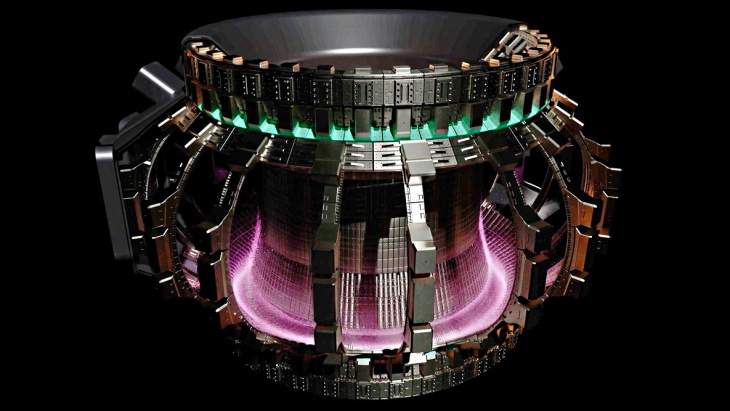
CFS accelerates commercial fusion with Siemens, NVIDIA
US private fusion company Commonwealth Fusion Systems is collaborating with multinational technology companies NVIDIA and Siemens to develop a digital twin of its SPARC prototype fusion machine that will apply artificial intelligence and data and project management tools to accelerate commercial fusion.
The digital twin will leverage data from the Siemens Xcelerator portfolio of industrial software, including its Designcenter NX for advanced product engineering and Teamcenter product lifecycle management tools, which Commonwealth Fusion Systems (CFS) uses to create, catalogue, and process machine designs and assemblies. These designs and assemblies can then be used in Commonwealth Fusion Systems’ modelling and simulation workflows, including the layering of AI-enabled tools.
Commonwealth Fusion Systems will use NVIDIA Omniverse libraries and OpenUSD to integrate data with classical and AI-powered physics models to create the digital twin of SPARC. This virtual replica of SPARC will provide Commonwealth Fusion Systems with a user-friendly way to run simulations, test hypotheses, and quickly compare the experimental results from the machine to the simulations. This ability to rapidly analyse data and iterate will speed Commonwealth Fusion Systems’ efforts to make fusion energy a commercial reality.
US Nuclear Regulatory Commission Approved 13 Reactor Licence Renewals in 2025
The US Nuclear Regulatory Commission (NRC) said it had authorised 13 licence renewals for reactors in 2025, that together would deliver 12,000 MW of power over the next 20 years.
In a report highlighting the commission’s achievements for the year, the NRC said it had also approved the first ever restart of a reactor following its decommissioning – the Palisades plant in Michigan.
The 805-MW pressurised water reactor unit at Palisades is now due to restart in early 2026, according to operator Holtec International, having ceased operations in May 2022.
Holtec bought Palisades to decommission the facility, which had struggled to compete with natural gas-fired plants and renewable energy, but in early 2023 applied to the Department of Energy for federal loan funding to repower the plant.
The 13 licence renewals were the Perry-1 nuclear power plant in Ohio; Oconee-1, -2 and -3 in South Carolina; Summer-1 in South Carolina; Point Beach-1 and -2 in Wisconsin; Browns Ferry-1, -2 and -3 in Alabama; Clinton-1 in Illinois; and Dresden-2 and -3, also in Illinois.
US Has Lost A Generation Of Nuclear Expertise As China and Russia Have Surged Ahead, Hearing Told
The US has watched critical skills atrophy and lost a generation of nuclear expertise as China and Russia have surged ahead, now accounting for 94% of reactors under construction worldwide, a hearing in Washington was told.
Mariannette Miller-Meeks, a Republican congresswoman representing a district of Iowa, told a subcommittee on energy hearing titled ‘American Energy Dominance: Dawn of the New Nuclear Era’, that competition from China and Russia isn’t just about electricity, “it’s about American jobs, domestic manufacturing, exporting knowledge, equipment, and secure supply chains”.
“Rebuilding our nuclear energy industry means rebuilding the workforce, supply chains, and the industrial base that comes with it,” she said.
Subcommittee chairman Bob Latta, an Ohio Republican, said the importance of the successful growth of the American nuclear energy industry “cannot be understated”.
“We need firm, reliable power, versatile power, and more of it. We need power for emerging industrial output and the AI race – also for homes and businesses.
“A robust and growing nuclear industry also strengthens our national security. It does so through increased nuclear commerce with allies and through a more cost-effective industrial base.”
Chinese tokamak achieves progress in high-density operation
Experiments at China’s Experimental Advanced Superconducting Tokamak have confirmed the existence of “a density-free region” of the tokamak, finding a method to break through the density limit and providing important physical evidence for the high-density operation of magnetic confinement fusion devices.
A tokamak device is a toroidal device that uses magnetic confinement to achieve controlled nuclear fusion, resembling a spiral ‘magnetic track’ that locks in high-temperature plasma to achieve nuclear fusion. Plasma density is one of the key parameters of tokamak performance, directly affecting the fusion reaction rate. In the past, researchers discovered that there is a limit to plasma density, referred to as the Greenwald density limit; once this limit is reached, the plasma breaks up and escapes the magnetic field confinement, releasing enormous energy into the inner wall of the device, affecting safe operation. Through long-term research, the international fusion community has discovered that the physical process triggering the density limit occurs in the boundary region between the plasma and the inner wall of the device, but the underlying physical mechanism is not fully understood.
A team at the Institute of Plasma Physics under the Chinese Academy of Sciences (ASIPP) in Hefei, Anhui Province, developed a theoretical model of boundary plasma-wall interaction self-organisation (PWSO), discovering the crucial role of boundary radiation in density limit triggering and revealing the triggering mechanism of the density limit. Utilising the all-metal wall operating environment of the Experimental Advanced Superconducting Tokamak (EAST) – known as the ‘artificial sun’ – they reduced boundary impurity sputtering by employing methods such as electron cyclotron resonance heating and pre-charged synergistic start-up, actively delaying the occurrence of the density limit and plasma breakup.