

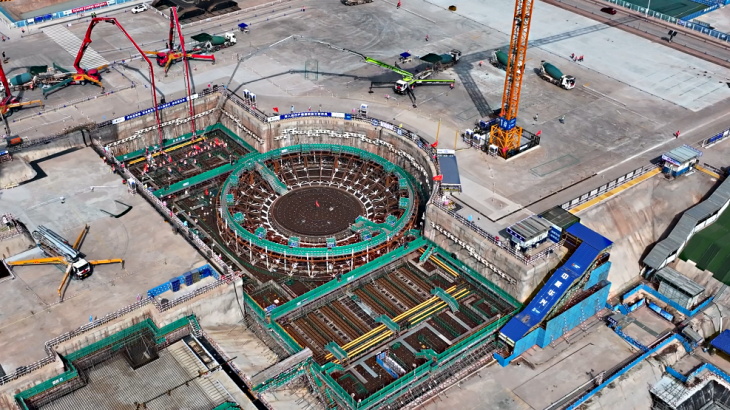
China begins construction of two new nuclear power units
First concrete has been poured for the nuclear islands of unit 1 of the Bailong nuclear power plant in China’s Guangxi Zhuang Autonomous Region and of unit 2 at the Lufeng plant in Guangdong province, marking the official start of construction of the two CAP1000 reactors.
The construction of Phase I (units 1 and 2) of the Bailong plant was among approvals for 11 new reactors granted by China’s State Council in August 2024. State Power Investment Corporation (SPIC) plans to build two CAP1000 pressurised water reactors – the Chinese version of the Westinghouse AP1000 – as the first phase of the plant. An investment of about CNY40 billion (USD5.6 billion) is planned for the two units, which are expected to take 56 months to construct. Excavation of about 66,000 cubic metres of earth to form the foundation pit – which will eventually be 12.2 metres deep and cover an area of about 3000 square metres – began in late December 2024.
SPIC subsidiary Shanghai Nuclear Engineering Research & Design Institute (SNERDI) – joint general contractor for the project – announced it poured the first concrete on 22 December for the basemat of the nuclear island at Bailong unit 1. The company said a total of a 6,662 cubic metres of concrete was poured in a process lasting just over 64 hours.
Located on Jiangshan Peninsula in Fangchenggang City, Guangxi Province, the Bailong plant is planned to have six units, with a total installed capacity of 8.62 GWe and a total investment of approximately CNY120 billion. The first phase of the project adopts the CAP1000 design, with each unit having a capacity of 1.25 million kilowatts. Four CAP1400 reactors are also proposed to be built at the site – located about 24 kilometres from the border with Vietnam and about 30 kilometres southwest of China General Nuclear’s Fangchenggang nuclear power plant – in later phases.
Zelenskyy Puts Forward Alternative Plan For Future Of Zaporizhzhia Nuclear Power Station
Ukraine would receive 50% of the electricity output from the Zaporizhzhia nuclear power station under a 20-point peace plan put forward by president Volodymyr Zelenskyy on 30 December that offered concessions to Russia in an effort to end the conflict in Ukraine.
The proposal slims down the 28-point peace plan proposed by the Trump administration and allots for the creation of a “fortress belt” composed of cities in the Donetsk region of eastern Ukraine to protect Ukraine from further invasion from Moscow.
Russian president Vladimir Putin has pushed to acquire all of the Donetsk region in peace negotiations and has made land cessation a requirement to end the war.
Instead of ceding land, Zelenskyy has offered to establish a demilitarised zone on the front lines that would require Russian and Ukrainian forces to withdraw from the areas defined in the agreement.
The Zaporizhzhia nuclear power station, Europe’s largest, is one of the main sticking points in US President Donald Trump’s peace plan to end the nearly four-year war between Russia and Ukraine.
As part of Zelenskyy’s plan, the Ukrainian government has proposed Ukraine would receive 50% of the electricity output from Zaporizhzhia and the US would control the other 50% of the plant and determine how to divide up its assets, CNN reported.
Zelenskyy was said to have rejected the previous proposal, in which the US, Ukraine and Russia would split the joint venture three ways, with each country obtaining 33% of the plant’s output.
“It is clear that for Ukraine this sounds very unsuccessful and not entirely realistic. How can you have joint commerce with the Russians after everything?” Zelenksyy said in an interview with NBC.
Zelenskyy had said ahead of a meeting with Trump at Trump’s Mar-a-Lago estate in Florida on Sunday that territorial integrity and control of Zaporizhzhia are non-negotiable, calling them Ukraine’s “red lines”.
He said countries have engaged in more than 15 hours of conversation about the plant, which has been occupied by Russian forces since soon after Mocow’s February 2022 invasion of Ukraine and is near the frontline of fighting in the southeast of Ukraine.
According to Modern Diplomacy, a Bulgaria-based online resource, the central question is not just ownership of Zaporizhzhia, but control over the energy produced and the safety protocols preventing catastrophe.
US Nuclear Fuel Makers Get $2.7 Billion As Washington Bids To End Reliance On Russia
The US is awarding $2.7bn (€2.3bn) to three nuclear fuel makers as part of an effort to restart domestic production and wean the US off of enriched Russian uranium.
The US Department of Energy (DOE) said the backing would strengthen domestic enrichment services over the next 10 years as part of president Donald Trump’s commitment to enhance energy security and reduce reliance on foreign suppliers.
It said the “historic” investment expands US capacity for low-enriched uranium (LEU) and jumpstarts new supply chains and innovations for high-assay low-enriched uranium (Haleu) “to create American jobs and usher in the nation’s nuclear renaissance”.
The funding will go to American Centrifuge Operating, General Matter and Orano Federal Services. Each company will get $900m.
American Centrifuge Operating, a subsidiary of US enrichment company Centrus Energy, will create domestic Haleu enrichment capacity. General Matter, a company backed by billionaire venture capitalist Peter Thiel, will also create domestic Haleu enrichment capacity, while Orano Federal Services, part of the Orano group, will expand US domestic LEU enrichment capacity.
Haleu is an advanced fuel that will be needed for many next-generation reactors and has enrichment levels of 10%-19.75%. LEU is used by existing reactors and has enrichment levels of 3%-5%.
The awards are part of an effort to build a secure domestic nuclear fuel supply chain and wean the US off cheap enriched Russian uranium. The US was once a top supplier of enriched uranium and now just has one major commercial enrichment facility in New Mexico, owned by Urenco, a British, Dutch and German consortium. However, Centrus Energy’s American Centrifuge Plant in Ohio produces LEU and has begun producing Haleu for advanced reactors.
America’s Reliance On Foreign Sources
According to data from the Energy Information Administration, Russia supplies roughly 24% to 27% of the enriched uranium – or enrichment services – for US nuclear power plants. After Russia, 12% of enriched uranium comes from France, 8% from the Netherlands, and 7% from the UK. The US relies on foreign sources for 71.7% of its enriched uranium.
The US Congress enacted the Prohibiting Russian Uranium Imports Act in May 2024, banning imports of Russian LEU. However, waivers are available, allowing continued imports from Russia until 2028 to prevent immediate reactor shutdowns, with a full ban taking effect later.
The announcement comes as Trump’s administration throws its weight behind expanding the US nuclear industry. Power demand is increasing with the proliferation of massive data centres needed for artificial intelligence.
“Today’s awards show that this administration is committed to working hand-in-hand with industry and Congress to build a secure domestic nuclear fuel supply chain capable of producing the nuclear fuels needed to power the reactors of today and the advanced reactors of tomorrow,” energy secretary Chris Wright said in a statement.
The DOE also awarded an additional $28m to Wilmington, North Carolina-based Global Laser Enrichment to continue advancing next generation uranium enrichment technology. That award is the result of a competitive solicitation issued last December.