

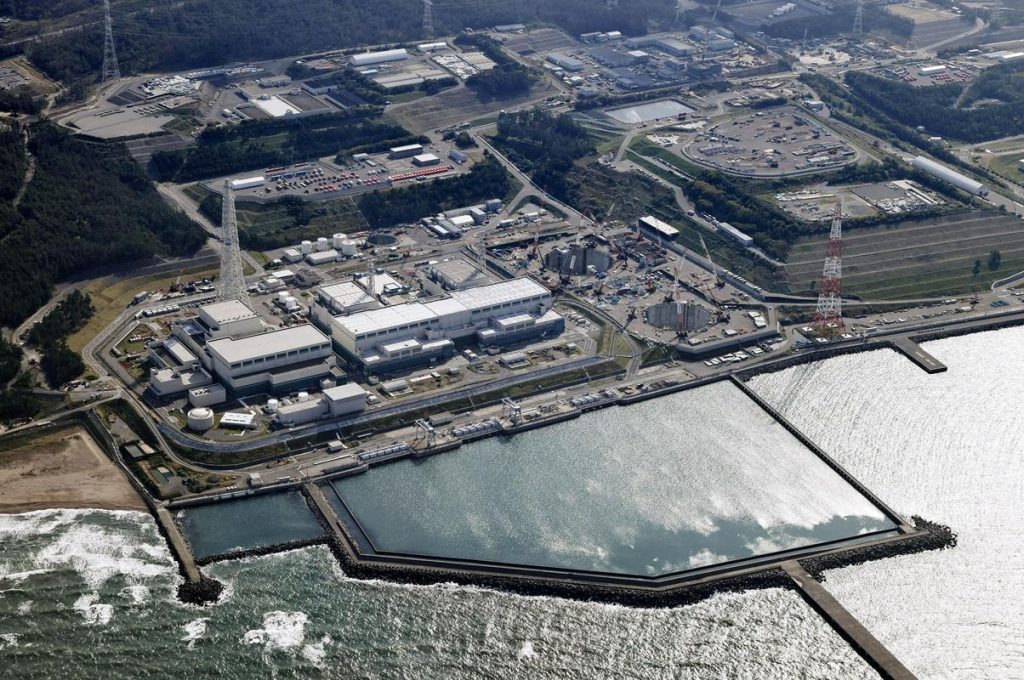
Restart of Kashiwazaki-Kariwa reactors approved by regional assembly
The Niigata Prefectural Assembly has backed Niigata Governor Hideyo Hanazumi’s decision to approve the restart of units 6 and 7 at Tokyo Electric Power Company’s Kashiwazaki-Kariwa nuclear power plant.
The approval came via a vote of confidence in the governor during the session on Monday, and means that the process of obtaining local consent is completed and Tokyo Electric Power Company (Tepco) can advance plans to restart the units.
The seven-unit Kashiwazaki-Kariwa plant was unaffected by the March 2011 earthquake and tsunami which damaged Tepco’s Fukushima Daiichi plant, although the plant’s reactors were previously all offline for up to three years following the 2007 Niigata-Chuetsu earthquake, which caused damage to the site but did not damage the reactors themselves. While the units were offline, work was carried out to improve the plant’s earthquake resistance. All units have remained offline since the Fukushima Daiichi accident.
AI tool can simulate complex fusion plasma in seconds
A team of scientists from the UK Atomic Energy Authority, the Johannes Kepler University Linz, and Emmi AI, have developed an artificial intelligence tool – named GyroSwin – which can create simulations up to 1,000 times faster than traditional computational methods.
Magnetic nuclear fusion is considered a promising technology for sustainable and emission-free energy supply. However, to achieve fusion, machines need to confine plasma at extreme temperatures using powerful magnets. Managing turbulence within the plasma is a key fusion challenge so it needs to be accurately modelled.
Plasma scientists rely on state-of-the-art numerical simulations, using five-dimensional (5D) gyrokinetics, which includes three spatial dimensions plus two additional dimensions which account for parallel and perpendicular velocity of particles within the plasma. This 5D approach requires immense supercomputing power. Traditional simulations are extremely slow and computationally expensive, significantly lengthening design and development cycles. Previously, computation methods simulated a plasma by actively calculating the complex plasma dynamics.
New York energy plan recognises role of nuclear
New York’s updated State Energy Plan recognises that a variety of energy sources – including advanced nuclear – will be needed to help the US state meet its overall energy needs over the next 15 years.
The State Energy Plan – approved by the State Energy Planning Board on 16 December – provides broad policy direction that guides energy-related decision making within New York State. The plan includes an outlook up to 2040 with recommendations for meeting future energy demands that prioritise an energy system that is affordable, reliable, and clean while supporting economic development, equity, and a healthy environment.
EDF estimates EPR2 programme cost at EUR72.8 billion
France’s EDF has said its preliminary cost estimate for the project to build six EPR2 reactors at Penly, Gravelines and Bugey totals EUR72.8 billion (USD85.3 billion).
The figure was presented to its board of directors on Thursday. The board approved a EUR2.7 billion budget allocation to the programme for 2026, the company said.
The cost estimate is to be audited in the first three months of 2026 by France’s Interministerial Delegation for New Nuclear Technology, which reports to the French president.
France submitted its proposed state aid measures for approval to the European Commission in November – they comprise a subsidised loan to finance at least half of the construction costs; a 40-year Contract for Difference; and risk sharing between the state and EDF.
US Regulator Approves 20-Year Licence Renewals For Three More Nuclear Plants
The US Nuclear Regulatory Commission (NRC) has renewed the operating licences of Constellation’s Clinton-1 and Dresden-2 and -3 nuclear power plants in Illinois for an additional 20 years beyond their current expiry dates.
The NRC said the renewed licence for Clinton-1, a 1,062-MW boiling water reactor unit, will now run until April 2047.
UK aims for cancer treatments from reprocessed uranium
A 15-year agreement between the UK Nuclear Decommissioning Authority and biotech firm Bicycle Therapeutics focuses on securing the medical isotope lead-212 from the UK’s stockpile of reprocessed nuclear fuel.
In total the Nuclear Decommissioning Authority (NDA) will provide Bicycle Therapeutics with access to 400 tonnes of reprocessed uranium over the 15 years.
The Cambridge-based biotech company will use technology developed by the UK’s National Nuclear Laboratory and it will extract lead-212 using a novel radioisotope generator developed for them by Spectron Rx.
The National Nuclear Laboratory explains that the “sophisticated chemical separation process isolates exceptionally small quantities of lead-212’s parent material from used nuclear fuel. To put the scale in perspective, the initial parent material extracted is comparable to finding a single drop of water in an Olympic swimming pool. From this already minuscule amount, an even smaller fraction of lead-212 is then separated for medical applications. These trace quantities can then be developed into radiopharmaceuticals – targeted treatments designed to combat some of the most challenging cancer types”.