

History of ICJT
For over 35 years, the ICJT has been dedicated to sharing knowledge and raising public awareness about nuclear science and technology.
Beginnings
The Jožef Stefan Institute (IJS), of which we are a part, has a long-standing tradition of training in the field of nuclear technologies. The first courses introduced were in radiation protection, and after the decision to build the Krško Nuclear Power Plant (NEK), the Institute became actively involved in the project.
In 1971 and 1972, the Institute organized the first training courses for the management staff of NEK, followed later by numerous courses for operators and technical personnel. During this period, the first domestic textbooks for basic nuclear training courses were also written.

Development
The Three Mile Island accident in 1979 clearly demonstrated how essential it is for nuclear safety to have personnel with a deep understanding of physics and nuclear fundamentals. This realization led to the 1981 inter-republic agreement to establish an Education Centre for Nuclear Technology in Ljubljana (and a Clinic for Nuclear Medicine and Radiation Protection in Zagreb).
Of course, it still took considerable effort and persuasion before this initial agreement began to materialize. The driving force behind these efforts was Dr. Mitja Najžer, then head of the Reactor Physics Department. His persistence and determination played a decisive role in the signing of the Self-Management Agreement on the Joint Work and Resources for the construction and operation of the Education Centre for Nuclear Technology in Podgorica in 1986.
The contracting parties were Elektrogospodarstvo Slovenije and the Jožef Stefan Institute. Construction of the building, financed mainly by Elektrogospodarstvo, began in autumn 1987 and was completed by the end of the following year.
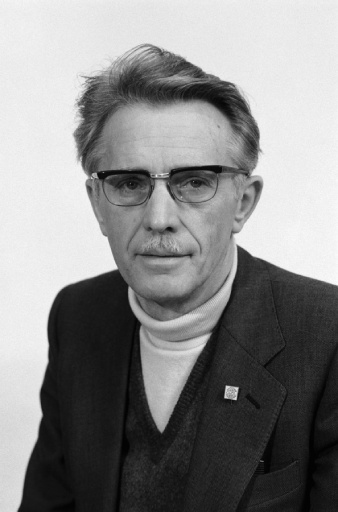
Milan Čopič (1925 - 1989)
Milan Čopič was one of the pioneers of reactor physics in Slovenia.
He completed his degree in physics in Ljubljana in 1951 and earned his doctorate in 1959.
During 1956/57 and 1959/60, he participated in nuclear research in the United States. He also lectured at the University of Kansas and in Stuttgart.
From 1960, he headed the Reactor Department of the Jožef Stefan Institute.
He was one of the initiators and organizers of the construction of the TRIGA research reactor in Podgorica near Ljubljana.
From 1970, he was a member of various working groups related to the Krško Nuclear Power Plant (NEK).
In 1982, he became a government advisor, and later the first director of the newly established Slovenian Nuclear Safety Administration.
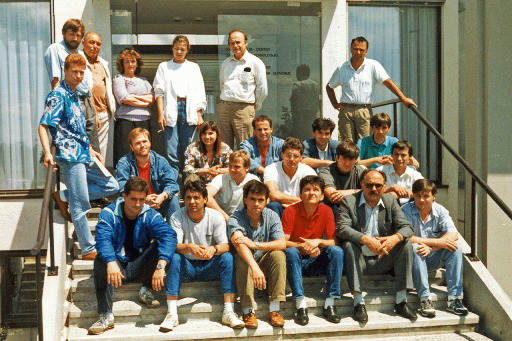
TJE course in 1989
Recent History
The first training course in the new premises began in January 1989. During that year, the facilities were equipped with the remaining necessary instruments, and on October 5, 1989, the Jožef Stefan Institute Council formally established the Milan Čopič Education Centre for Nuclear Technology as an independent unit of the Institute.
The first head of the Centre was Dr. Mitja Najžer, and the Centre was named in honor of Dr. Milan Čopič, one of the founders of nuclear science at the Jožef Stefan Institute.
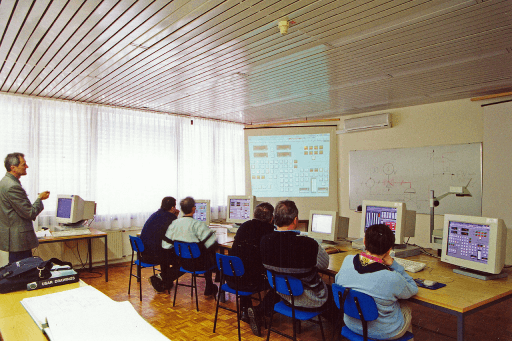
Training on the simulator, 1997
The 1990s
In the early 1990s, the ICJT primarily focused on training future operators of the Krško Nuclear Power Plant (NEK). At the same time, the Centre was also responsible for organizing training courses within the framework of the International Atomic Energy Agency (IAEA) technical assistance programs.
An important milestone was the acquisition of a school simulator of basic reactor principles, purchased by NEK in 1997, which has been operating in the ICJT premises ever since.
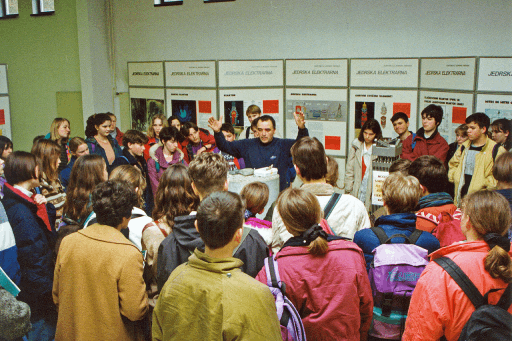
Visit of schoolchildren, 1995
The Exhibition and Public Outreac
In the spring of 1991, an exhibition titled “Electricity from Nuclear Energy” was set up in the previously unused basement rooms of the ICJT. This exhibition became the foundation of the Information Centre for Nuclear Technology, which, since 1993, has been regularly welcoming visitors, especially school groups.
In 1998, the Agency for Radioactive Waste (ARAO) joined as a partner in the Centre’s information activities, and the ICJT became its official Info Centre. Over the years, the exhibition has expanded and been regularly updated, while the ICJT has also published numerous popular science booklets and brochures, both independently and in cooperation with the Nuclear Society of Slovenia.
In 2005, the exhibition was expanded to include a section on fusion physics and technology, and the following year, a display marking 40 years of operation of the TRIGA research reactor was added.
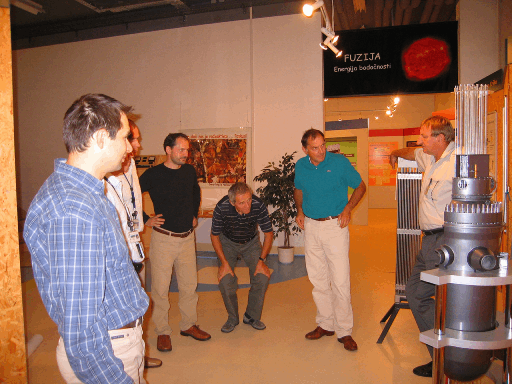
Model of the reactor vessel, 2006
International Recognition and Modern Activities
By the late 1990s, the ICJT had established itself as a renowned organizer of international seminars and workshops. In 2000, the International Atomic Energy Agency (IAEA) designated the Centre as a Regional Resource Centre.
During the first decade of the 21st century, ICJT’s international activities further expanded to include workshops within the European Union framework and the organization of scientific conferences, particularly in cooperation with the research departments of the Jožef Stefan Institute.
The newest international initiative is the organization of the traveling exhibition “Fusion Expo.”
As part of the Jožef Stefan Institute, ICJT is officially authorized in the fields of radiation and nuclear safety, as well as for training in radiation protection. Within these official responsibilities, an important milestone was the acquisition of the ISO 9001 quality certificate in 2006, making ICJT the first organizational unit of the Institute to achieve this distinction.
214.889
Visitors
1.297
Courses
13.478
Participants
36
Years